The iconic Lucy fossil continues to be promoted by evolutionists as evidence for human evolution. In this article from Live Science, the author uses a wide variety of word tactics in order to influence readers into accepting evolution, such as the use of assumptions, guesswork, cautionary tales, fallacious arguments, and faulty logic.
Consider, less than 40 percent of Lucy’s bones were discovered in 1974. That alone should spur skepticism. Yet Lucy (Australopithecus afarensis) remains an evolutionary centerpiece.
You see, one of the evolutionist’s main assertions regarding Lucy is that australopithecines could walk upright like humans. In fact, the author plainly states, their “discovery pointed to the possibility [emphasis mine] that human ancestors could walk upright long before they evolved bigger brains.”
Did you catch that? Evolutionists believed it was “possible” that Lucy could walk upright. Interestingly, they have never demonstrated bipedalism in these ape-like animals to be fact; just that they think it’s possible. So we might ask, why do they believe this? What makes them think it’s possible? Chimpanzees don’t have an upright posture, nor do gorillas, nor orangutans. So why should we think Lucy did?
First, keep in mind that only 47 out of 207 bones were found, and they were fragmentary, so there’s little evidence to go on. Nonetheless, evolutionists claim there’s a mixture of ape-like and human features. They claim she has a human-like spine, pelvis, knee and foot bones (even though they didn’t find any foot bones). But here’s the key: not everyone agrees. Other scientists have produced contrary studies, indicating that the spine, pelvis and knees are more similar to a chimpanzee and are better suited to swinging, but not efficient for walking upright!
In other words, it’s the evolutionist’s imagination that allows them to see what they want to see. They see a possibility for Lucy to walk upright based on demand. Without it, their case for evolution weakens.
A second reason why evolutionists believe Lucy walked upright is because human footprints were found in Laetoli, Tanzania. But these footprints were dated at about 3.7 million years old, which means, for an evolutionist, they couldn’t have been made by humans. Therefore, they conclude, these footprints must have been made by australopithecines, which suggests they were walking upright! Voila!
Once again this amounts to circular reasoning. But if we remained skeptical of evolution, then there’s no reason to demand these footprints are anything other than human. Why? Because the footprints contain human anatomy. Even evolutionists agree. According to the Natural History Museum, “The prints resemble those of modern humans, with an arch and a big toe aligned with the other toes. Their steps were also similar to those of modern humans, with the heel touching the ground first and weight transferring to the ball of the foot before the toes push the foot off the ground.”
Sadly, evolutionists cannot accept that these are human footprints because it would refute so much of evolutionary theory. Interestingly, the foot bones of a baby australopithecine (named Selam) were discovered back in 2000, studied in 2009, and scientists determined its toes were curved for gripping and climbing, unlike a human. Therefore, it’s unreasonable to claim that the Laetoli footprints are anything other than human.
Now that we understand why evolutionist’s need Lucy to walk upright, let’s investigate the premise of the Live Science article. Researchers were conducting 3D modeling to help understand how Lucy walked. But get this… the author explains what scientists had to do in order to show that Lucy could “probably” stand up straight like modern humans. Ready for this? Since Lucy’s muscles and other soft tissue had decayed, they obviously couldn’t use australopithecine muscles as an analog to piece her together. No. They plainly say they used “modern humans as analogs.” Shhhh…
This is incredible! Evolutionists will go to such great lengths to indoctrinate the public, and this is a perfect example. In order to prove that Lucy is our ancestor and could stand upright like modern humans, they had to use human anatomy. This trick provides the self-serving results needed to promote evolution. But they couldn’t have done it without assuming evolution.
Most people reading the article won’t be able to discern the deception. They’ll accept it because they already believe it, or because they’re expected to. Despite all kinds of cautionary language by the author, too many will be convinced Lucy really could stand upright like modern humans.
The author openly admits the data is based upon an incomplete skeleton, yet encourages the reader to accept it anyway because it’s the “consensus” opinion, and insists this is an “exciting method to confirm bipedalism.” But that’s deceptive. The conclusions were based on circular reasoning. So, rather than confirming bipedalism, this is a classic example of confirmation bias. The fix was in.
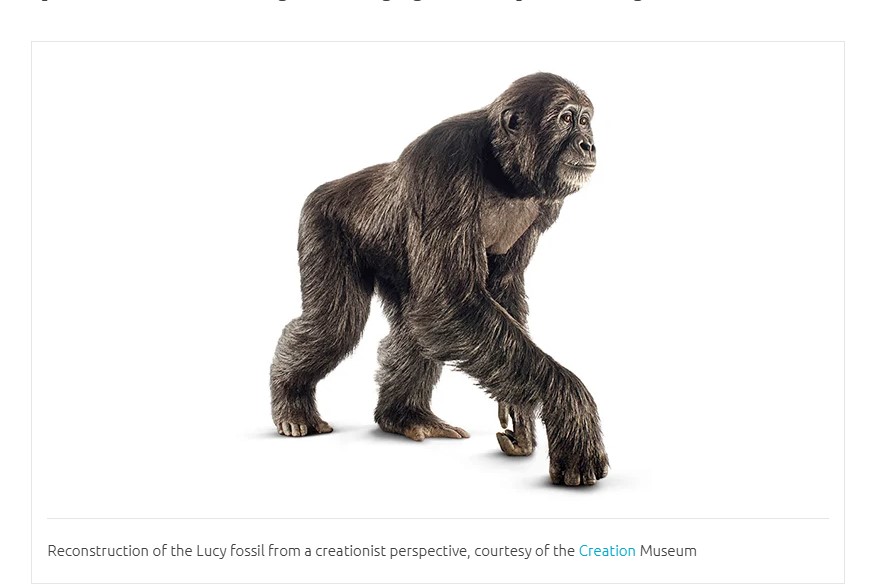
A better, less sensational interpretation of the evidence is that Lucy is an extinct ape-like creature that walked and climbed similarly to chimpanzees. Simple.
Lastly, I’d argue the evidence more closely supports Genesis, which tells us that God created man in his image, from the dust of the ground. Therefore, man did not evolve from any other animal. This is unacceptable for evolutionists, but is consistent with observable scientific evidence.
 sixdaysblog
answer from my perspective? possible, maybe even probable. but the bones themselves can’t tell if ‘she’ actually did. and it wouldn’t matter to my Faith one Iota. Humans are not ‘lucy’. we are not the same at all.
Thanks, I appreciate your perspective. And I certainly agree we can’t tell from the bones… especially with only a small sample of fragmented bones.
Reblogged this on clydeherrin.