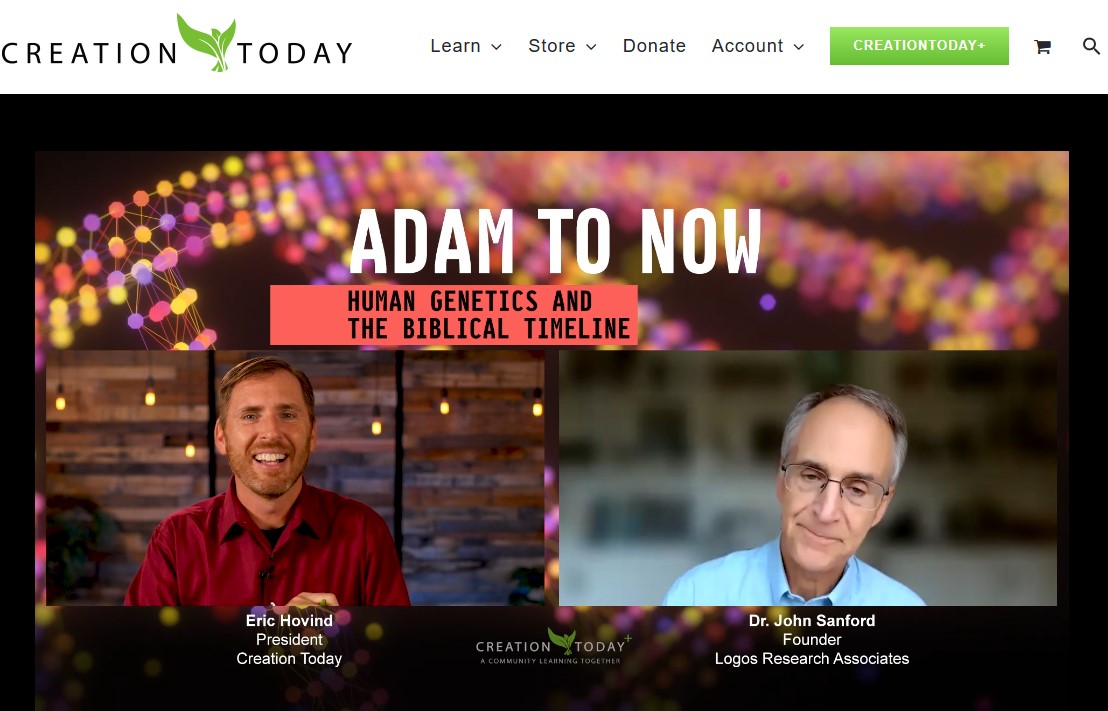
Here are two informative interviews conducted by Eric Hovind from Creation Today as he discusses human genetics with Dr. John Sanford and Egyptian Archeology with Nate Loper. These two interviews contain many convincing evidences supporting creation and biblical history. Here’s a brief rundown:
1: Dr. Sanford described himself as a “rabid atheist” after becoming interested in science in high school and continuing into college. Later, after ten years of marriage, his wife began going to church for the first time, and he tagged along out of curiosity. But then something unexpected happened… he fell in love with Jesus. He was baptized at the age of 39 and was “radically changed”. However, he still believed in evolution, thinking there was no other option. So he tried fitting evolution into Scripture. But after gathering a stack of evolution books and a stack of creation books he had a “God moment” and realized creation was true. Soon after he decided to concentrate on genetics.
On the origin of life Dr. Sanford says, “More and more people actually understand that life is unbelievably intricate. It is information systems on top of information systems on top of information systems. It’s like an operating system, but Bill Gates says it’s much more sophisticated than our best computers, and when you start to realize that, it’s clear that life cannot arise spontaneously. And to kickstart life, you need so many miracles to happen all at the same time and same place and same moment. It’s laughable, except people keep sweeping it under the rug. There are more and more evolutionists acknowledging this can only be by design.”
He’s right on. I’ve seen so many people sweep these complex systems under the rug, as if it’s really not a big deal for nonliving chemicals to come to life via natural processes.
Dr. Sanford goes on to discuss a biological decay curve that supports the long-life spans reported in the Bible, and he shows how the accumulation of mutations in the human genome is leading us toward extinction, and, if we trace these mutations backwards in time, we get to the point where the first humans (Adam and Eve) would have had no mutations, just as the Bible suggests. He shares evidence from secular science in the form of Mitochondrial Eve, supporting the biblical claim that all human beings come from one woman. Then there’s evidence in the form of Y-Chromosome Adam, demonstrating that all Y-chromosomes come from one man, just as the Bible says. There’s also evidence of an ancient human bottleneck, supporting a global flood, a divergence curve, suggesting Adam would have lived fairly recently- about 7,500 years ago, and a refutation of ape-to-human evolution.
2: The Nate Loper interview was fascinating, as he presents a list of archeological evidence from Egypt supporting biblical history. He mentions the Jacob Scarab (27 different seals), pointing to Jacob (Israel) and his relationship to God. Then there’s the Soleb Inscription, the earliest mention of Yahweh, which was found on a pillar in Egypt along with a reference to the Israelites being wanderers.
Archaeologists found 382 cuneiform tablets from Canaanite and Amorite leaders begging Amenhotep III for help against the Hebrew (‘Habiru’) people. Known as the Amarna Letters, one tablet says, ‘The Habiru are now attempting to take Jerusalem.” Another declares that the Habiru have captured the city of the King. There’s also mention of these people once being slaves, but they’re now overrunning the land.
Two scarabs naming Thutmose III were discovered in an altar built by Joshua (Deuteronomy 11:29, Joshua 8:30-31) on Mount Ebal, thus helping date the Exodus to about 1400 or 1446 BC.
Another reference to Israel is found on the Merneptah Stele, a large Egyptian artifact created during the period of the Judges, referring to Israel prior to having a king.
An artifact known as the Berlin Pedestal likely refers to Israel, but is incomplete and dates to around 1300 BC.
Loper does a fine job describing these artifacts, details their significance, and explains how they relate to recorded history, where God led his people into Egypt, and then the promised land.
If you love history and science, these are two worthwhile interviews to catch.

 sixdaysblog