The headline on this article from Sci Tech Daily states: “Breathtaking Discovery: Unearthing Microfossils That Redefine Life’s Evolution.” And the related artwork depicts a split-picture with earth on one side and an alien world on another. Then the article goes one step further, claiming that this discovery could also redefine “the potential for complex life forms in the universe.” Sounds mind-blowing, huh?
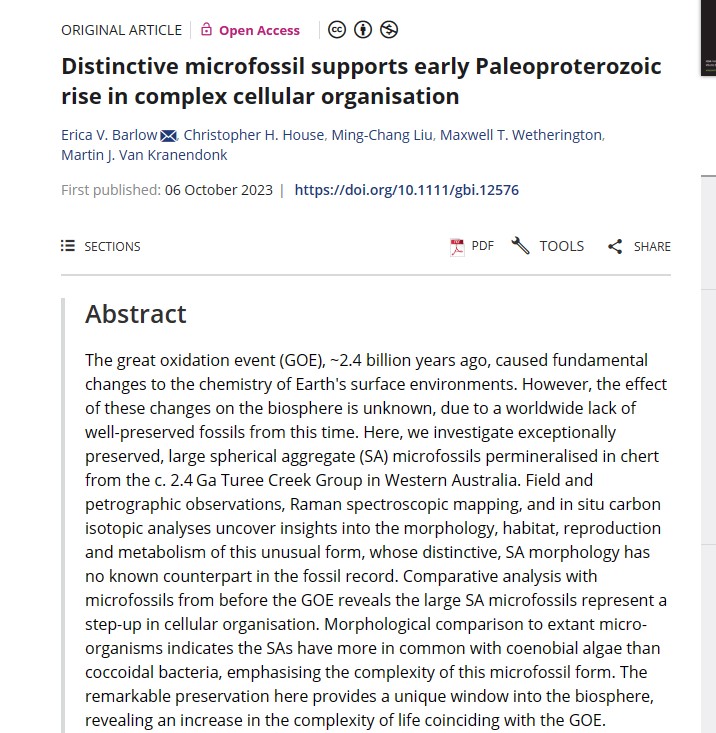
However, when we take a closer look, there’s a lot of backtracking, and less certainty. We learn that these microfossils were found in Australia and resemble a more complex type of life, like algae, rather than a simple prokaryote, like bacteria. In fact, Professor Erica Barlow said, “The microfossils have a remarkable similarity to a modern family called Volvocaceae.”
This is puzzling to scientists because they weren’t predicting to find something so complex or modern.
According to researchers these fossils are supposedly 2.4 billion years old and are “remarkably well preserved.” Note, after 2.4 billion years, the algae still look like modern algae.
An important point they wish to make is that the sudden appearance of these microfossils coincide with the Great Oxidation Event (GOE), a time when there was a rise in oxygen in the atmosphere and oceans. This is significant to evolutionists because it “hints” that a rise in oxygen levels caused new organisms to evolve, including these complex microfossils. But a hint doesn’t amount to more than speculation.
One major problem with this is, according to NASA, there were already significant amounts of oxygen in the oceans long before the Great Oxidation Event. So there’s not enough evidence to assume the GOE caused the rise of complex life.
Barlow goes on to state, “The record seems to reveal a burst of life — there’s an increase in diversity and complexity of this fossilized life that we are finding.” Hmmm. This seems more consistent with what creationists expect. Creationists expect the earliest life forms to “burst” suddenly on the scene with no evidence of previous ancestors. In fact, bursts of life seem to be the rule rather than the exception (i.e, Cambrian Explosion). The author also refers to this as a “significant leap” and “jump.”
Barlow continues: “There is nothing like them in the fossil record, and yet, they have quite striking similarities to modern algae.” Again, this lack of evolution is consistent with creation, which expects early algae to resemble modern algae. Algae reproduces algae. Algae doesn’t evolve into a different kind of organism- just algae.
Keep in mind that evolutionists believe the earth is 4.5 billion years old. They also believe the earliest “uncontroversial” evidence for life is 3.5 billion years old, and many suggest life began shortly after the earth formed, maybe as early as 4.29 billion years ago. That’s about 200 million years for abundant water and life to arise from when the earth was still a molten ball of magma. Something doesn’t add up, and some scientists recognize this conundrum. Then, 2.4 billion years ago we suddenly have complex life without any evidence that they evolved from a simpler organism. Sounds more like fantasy than science.
In total, the article doesn’t really tell us much about evolution, except that evolutionists believe it. I think it tells us more about those who believe in evolution than evolution itself. For instance, if one believes life could arise from nonlife via naturalistic means, then this discovery only muddies the water by shortening the evolutionary time frame for life to go from simple to complex.
Evolutionists suggest this discovery implies we could find complex life on other planets. Why? Because they weren’t expecting to find complex life on earth where they found it, so maybe complex life exists on other planets where it wouldn’t be expected too. See how that works? There’s no evidence for evolution in this article, just that if one believes it, then new discoveries can shape and mold those beliefs.
Of course I think the evidence better fits creation. The microfossils were buried in a global flood, and their sudden appearance in the fossil record, fully formed, suggests they were always a type of algae and didn’t evolve from something else. The flood also explains the mass extinction mentioned. We don’t need evolution or billions of years to explain life on earth. God’s creation offers the best explanation. Further, I’d suggest the fact that the evolution of life can be “redefined” is evidence that it’s not a valid theory.
 sixdaysblog
Great work!
Thank you, much appreciated!