What if the biblical story about Noah’s flood were just a “local” flood—a regional disaster tucked away in Mesopotamia, not much different than any other flood in history? Would that account really deserve six chapters of Genesis, as well as references in the New Testament? Would such a flood matter at all, beyond the people who happened to live near it?
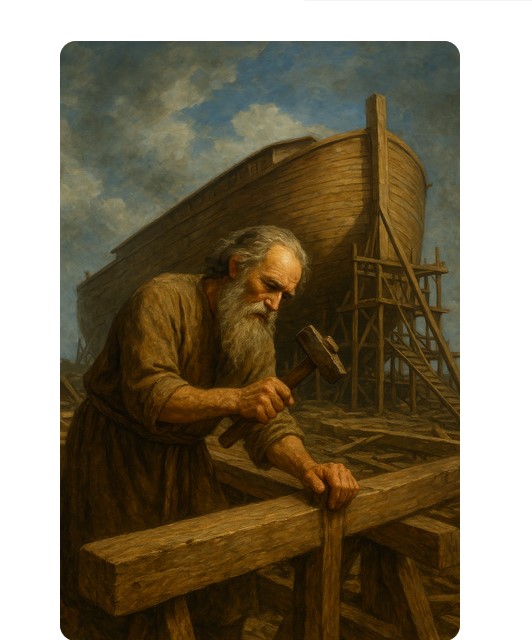
That question goes to the heart of the debate. The Bible plainly records a global flood. It begins in Genesis 5 with Noah and ends in Genesis 10 with the nations spreading across the earth. For thousands of years, believers understood it as a real, worldwide event that reshaped human history. But today, some Christians insist it was only a local flood. Why the change?
Why People Doubt a Global Flood
Non-Christians reject the idea outright, because a worldwide flood would require acknowledging a miracle—and secular science has no room for miracles. But what’s more surprising is that some Christians also deny a global flood. Why? Some trust secular science over Scripture. Others think Genesis is simply misinterpreted. And for many, it’s because they were taught to doubt the Bible’s plain meaning by our culture and schools.
Scripture Speaks for Itself
The first and strongest evidence for a global flood is the Bible itself. Genesis is written as historical narrative. Just as Abraham, Joseph, and Moses lived in real time and space, so did Noah. The traditional Christian view has always been that God revealed the creation of the world, the global flood, the Tower of Babel, and then the story of Abraham. Few Christians question Abraham’s historicity, but strangely, many doubt a global flood. Why? I’d suggest it’s the result of secular indoctrination.
For thousands of years, God’s people believed the flood was global. From the ancient Israelites, through the church fathers, and on until Darwin’s era, that was the prevailing understanding. Only when evolutionary theory and long ages gained popularity did Christians begin retreating from the historic view. So the claim that we’re only now “finally” interpreting Genesis correctly is simply not credible. The traditional interpretation wasn’t a mistake—it was the right one.
Who Knows the Text Best?
Those who insist the flood was local claim they’re “properly interpreting” the Bible. But think about that. They live thousands of years after the fact, never spoke the original language, and lean heavily on modern science that rejects the very possibility of miracles. Is it really reasonable to think today’s reinterpretations are more reliable than the plain understanding held by the people closest to the text? I would argue it’s naïve at best, and arrogant at worst.
The truth is simple: the ancient audience knew exactly what was meant. And they believed God revealed a global, historical flood.
Myth or History?
Another claim is that the flood story is mythological—borrowed from Mesopotamian legends, exaggerated over time, or invented as a metaphor to explain human existence. But if that’s true, then the biblical writers were liars, fools, or frauds. Worse, it means they were not speaking from God at all.
That’s the real problem with the local-flood or myth interpretation: it erases God from the picture. If God really warned Noah, commanded him to build an ark, and judged the world through a flood, then it was a deliberate act of divine judgment. And such judgment was global, not regional.
The Heart of the Matter
At the end of the day, this isn’t about geology, archaeology, or ancient floodplains. It’s about authority. If Christianity is true—if the Bible is literally the Word of God—then its account of a global flood cannot be reduced to myth, metaphor, or a minor Mesopotamian flood. God’s revelation supersedes secular myths.
Christians should not surrender biblical truth to secular science, no matter how sophisticated it sounds. If God exists, then His Word speaks with greater authority than human theories.
So here’s the challenge: If you believe in God, then take Him at His Word. Accept the flood as a global, historical catastrophe. Anything less drains the account of its weight and power. Why would God devote so much of Genesis to a local event of no lasting consequence?
But if the flood was global, then the story has profound value throughout Scripture and today: it’s a reminder of God’s holiness, His judgment, His mercy, and His faithfulness to preserve humanity through one man and one family. That is not myth. That is history—and it matters for us today.
 sixdaysblog