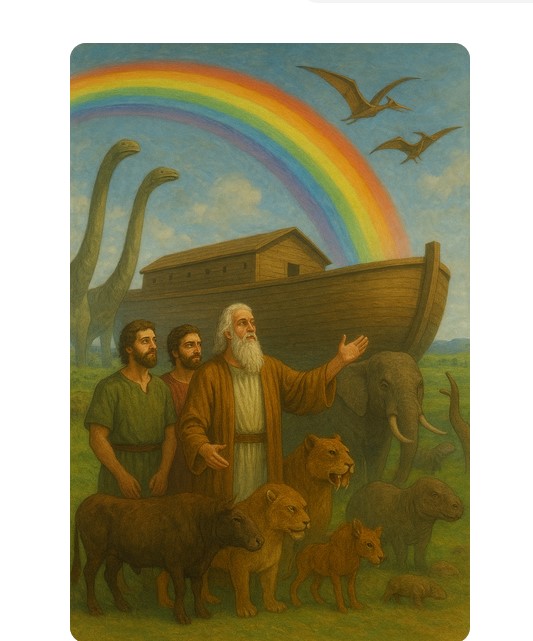
In this fourth part of our series, we turn from Genesis to the rest of Scripture to ask a vital question: did other biblical writers believe Noah’s flood was global? If the flood was merely local, we’d expect the rest of Scripture to reflect that. But if it was global—an event that reshaped the entire earth—then the testimony of God’s Word should be unified.
Isaiah 54:9-10 speaks about God restoring Israel, and the days of Noah are used in comparison:
“To me this is like the days of Noah, when I swore that the waters of Noah would never again cover the earth. So now I have sworn not to be angry with you, never to rebuke you again. Though the mountains be shaken and the hills be removed, yet my unfailing love for you will not be shaken.”
Here, God Himself speaks of His oath that the “waters of Noah would never again cover the earth.” If the flood were local, His promise would have been broken countless times since. Local floods have devastated regions throughout history. But if Noah’s flood was global, the promise holds perfectly true. This is what gives God’s comparison power and meaning. Just as His covenant with Noah was final, so is His covenant of peace with Israel. God Himself verifies the extent of the flood in Genesis 9:11, leaving no ambiguity: “Never again will I destroy all life by the waters of a flood; never again will there be a flood to destroy the earth.”
These are not human interpretations—they are divine declarations. The Creator who sent the flood confirms its global nature.
Psalm 104:5-9 echoes this global event: “(5) He set the earth on its foundations; it can never be moved. (6) You covered it with the watery depths as with a garment; the waters stood above the mountains. (7) But at your rebuke the waters fled, at the sound of your thunder they took to flight; (8) they flowed over the mountains, they went down into the valleys, to the place you assigned for them. (9) You set a boundary they cannot cross; never again will they cover the earth.”
Some argue this describes only creation, claiming that God’s “boundary” (v. 9) prevents another global flood. But that interpretation creates a contradiction with Genesis 7:19-20, which records that during the flood “all the high mountains under the entire heavens were covered.”
If Psalm 104 referred only to creation, then the flood of Noah would have violated that boundary—contradicting God’s Word. However, if verses 6- 9 describe Noah’s flood, everything aligns perfectly: the waters covered the earth, fled at God’s rebuke, and He established a new boundary- never again to be crossed. Far from disproving the flood’s global nature, this psalm affirms it and reinforces God’s covenant promise.
The apostle Peter also draws a clear line between creation and the flood in 2 Peter 3:4-7: “They deliberately forget that long ago by God’s word the heavens came into being and the earth was formed out of water and by water. By these waters also the world of that time was deluged and destroyed. By the same word the present heavens and earth are reserved for fire, being kept for the day of judgment and destruction of the ungodly.”
Peter emphasizes that the same waters which formed the earth also destroyed “the world of that time.” He doesn’t refer to a region or a valley—but the world. His comparison between the flood and the coming judgment of fire only makes sense if both are global. A local flood would undermine the very warning Peter intends to give.
Other books confirm Noah’s historical reality. Ezekiel, Matthew, Luke, and Hebrews all reference Noah and the flood as factual events. Luke even traces Jesus’ genealogy through Noah and back to Adam (Luke 3:23-38). Such a record only makes sense if Noah was a real person in human history.
Taken together, these passages show a consistent biblical picture. The prophets, poets, apostles, and even Jesus Himself spoke of Noah and the flood as genuine history—never as allegory, metaphor or myth. None hint at a local flood. The writers of Scripture, under divine inspiration, affirmed a global event. Bible-believing Christians, therefore, have every reason to trust the plain reading of God’s Word.
In the final part of this series, we’ll look at scientific evidence supporting a global flood. While Scripture stands as the ultimate authority for believers, God’s world and God’s Word are never in conflict. As Romans 1:20 reminds us, “Since the creation of the world God’s invisible qualities—his eternal power and divine nature—have been clearly seen, being understood from what has been made, so that people are without excuse.”
And 1 Peter 3:15 calls us to “Always be prepared to give an answer to everyone who asks you to give the reason for the hope that you have. But do this with gentleness and respect.” That includes being prepared to show that science—when viewed honestly—confirms the truth of Scripture rather than undermines it.
The Bible speaks with one voice: Noah’s flood was not a local disaster but a global judgment. The same God who once covered the earth with water now covers His people with grace. His covenant stands, His Word remains sure, and His love endures forever.
 sixdaysblog
Hello from the UK
Many thanks for your post. The earth was covered with water prior to forming of the landmass so it would be resonable for the earth to be covered again by water in a catastrophic global flood.
Greetings! And thanks for your comment. Spot on.