When headlines proclaim that a single fossil “changes the story of human origins,” it should immediately raise an obvious question: why? If human evolution were a well-established, predictable process, as we are so often told, then new discoveries should neatly fit within that framework, not overturn it. Yet once again, an article from SciTechDaily claims that a newly analyzed fossil does exactly that. The headline reads: “This 3.4 Million-Year-Old Foot Changes the Story of Human Origins.” Really?
If modern humans truly descended from ape-like ancestors through a long, gradual process, why does the story keep changing? What, exactly, did evolutionary theory get wrong this time?
As it turns out, this “changing story” is not an anomaly; it’s a recurring pattern. Rather than confirming a smooth, linear transition from ape to human, new fossil discoveries routinely challenge evolutionary expectations and leave evolutionists scrambling to revise their models.
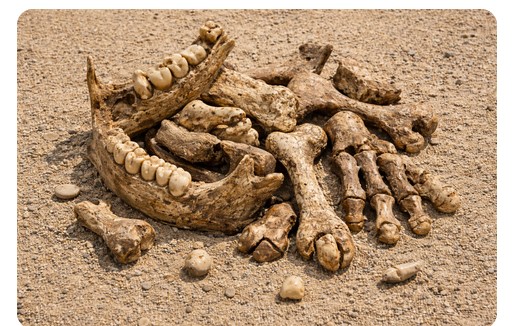
The fossils in question come from the Burtele region of Ethiopia. In 2009, researchers discovered teeth in the area, followed later that year by fragments of a foot. In 2011, scientists announced the discovery of a new species based on a maxilla and mandible, which they named Australopithecus deyiremeda. After analyzing the entire collection, they concluded that all the fossils belonged to the same species. Radiometric dating was then used to assign an age of 3.4 million years.
I reject that date. Radiometric dating is not an objective time machine; it is a method built upon assumptions about the past that cannot be verified. At best, it can establish relative order- what layer came before another- but the absolute ages assigned are interpretive. Once that is understood, there is no need to invoke evolution to explain human origins. A biblical framework provides a coherent and historically grounded explanation.
However, even for those who accept secular dating methods without question, serious problems remain. Evolutionary theory depends heavily on the assumption that similarity implies ancestry. Creationists recognize that this assumption is unnecessary. Similarity does not demand common descent. Just because cats and dogs have fur doesn’t mean they share a common ancestor. A more reasonable explanation is that they have fur because God designed them with similar features. In other words, they share common design (not ancestry).
Now consider one of the article’s claims: “The evidence shows that multiple early human ancestors inhabited the same region while relying on different diets and behaviors.” Notice that the conclusion is embedded in the premise. Evolution is assumed from the outset. But what empirical evidence do they provide demonstrating that A. deyiremeda is related to humans? None. The relationship is simply asserted, then repeated, until it is treated as fact.
Even granting evolution for the sake of argument, there is evidence that cuts against this claim. One only needs to follow the data objectively.
This leads to another important issue: Most people understand that chimpanzees, gorillas, orangutans, gibbons, and monkeys are not human. Yet evolutionists routinely label extinct ape-like creatures as “early” or “ancient” humans. This functions as an indoctrination tactic, conditioning readers to accept evolution as fact before they even evaluate the evidence. The first step is to question whether these animals have any real connection to humans at all.
Throughout the article, the researchers repeatedly express surprise at their findings. But predictability is a hallmark of good science. When scientists are continually surprised, it suggests that their underlying assumptions are flawed.
For example, deyiremeda is described as “unusual” because it is compared to Australopithecus afarensis (Lucy’s species) which is said to have lived in the same region between 3.9 and 2.9 million-years-ago. If evolution were correct, deyiremeda, dated to 3.4 million years, should appear more human-like than afarensis. Instead, its foot is considered more “primitive” because it retains an opposable big toe, ideal for climbing. Afarensis, by contrast, is said to have been fully bipedal, with toes aligned for upright walking. So they’re surprised because they’re not seeing the kind of change predicted by evolutionary theory.
This is not the first time such surprises have occurred. Evolutionists were already caught off guard when Ardipithecus ramidus (4.4 MYA) was found to have an opposable big toe. Now, discovering the same feature in deyiremeda only deepens the problem. These animals walked like apes, not humans.
To be clear, deyiremeda’s foot is well designed for grasping branches and climbing. Even within an evolutionary framework, this makes a human relationship unlikely.
Yet, based on 33 fractured bones, researchers still insist that deyiremeda, afarensis, and ramidus were early human ancestors. Paleoanthropologist Yohannes Haile-Selassie stated, “The whole idea of finding specimens like the Burtele foot tells you that there were many ways of walking on two legs when on the ground, there was not just one way until later.” So, rather than abandoning a failing theory, they reshape it to fit their paradigm.
Additional surprises followed. Deyiremeda’s diet was more narrow than that of africanus, contradicting the expectation that human ancestors should be evolving in the same general direction. Even more revealing were the findings about growth and development. Researcher Gary Schwartz noted that deyiremeda grew in patterns similar to “living apes and other early australopiths, like Lucy’s species.” You don’t say?
In other words, they were fully ape.
Despite increasing awareness of their diversity, these creatures all shared ape-like growth patterns- not human ones. The evidence consistently points away from human ancestry, yet the evolutionary narrative is preserved at all costs.
These discoveries do not strengthen the evolutionary story of human origins; they refute it. Our origin has already been revealed. Scripture tells us that God formed Adam from the dust of the ground and breathed life into him (Genesis 2:7). Luke’s genealogy affirms that Adam is the son of God (Luke 3:38).
The only reason these fossils are “surprising” is because evolution is assumed to be true. Remove that assumption, and the evidence makes far more sense for special creation.
 sixdaysblog