There’s a reason why new lifeforms do not spontaneously appear from time to time. The universe, governed by fixed laws and chemical constraints, is simply not hospitable to such events. Life does not arise from primordial soups, rotting meat, hydrothermal vents, meteorites, clay, or diamonds. In the 19th century, Louis Pasteur experimentally refuted the doctrine of spontaneous generation. The Law of Biogenesis- life comes from life- stands firm.
Yet many scientists insist that the first living organism emerged from nonliving material over four billion years ago, eventually evolving into all life on Earth. The difficulty is obvious: even the simplest cell is staggeringly complex. Abiogenesis is not merely an unsolved problem; it is a problem of extraordinary improbability.
So when I read a recent article at Phys Org, titled, “Could the discovery of a tiny RNA molecule explain the origins of life?” I examined the claim carefully. How life originated is one of science’s greatest mysteries-at least for those who reject divine creation. The article correctly notes that life requires the ability to reproduce. That, in turn, demands a molecule capable of storing genetic information, performing catalytic work, and copying itself.
Enter the RNA World hypothesis. According to this popular model, RNA once functioned both as genetic material and as a catalytic molecule before DNA and proteins assumed their modern roles. But RNA itself is a highly complex polymer. In contemporary cells, RNA is transcribed from DNA and depends on sophisticated enzymatic machinery. To suggest that RNA preceded DNA only relocates the explanatory gap; it does not resolve it. If RNA came first, what encoded it? What stabilized it? What drove its replication in a prebiotic environment that would degrade such molecules?
The hypothesis persists because evolution requires a starting point. Without life, evolution cannot begin. Thus, RNA is proposed as the necessary bridge. But the proposal rests on assumption layered upon assumption. The existence of a replicating RNA system is inferred because it must have existed for the theory to proceed. That is circular reasoning. Empirical evidence is absent.
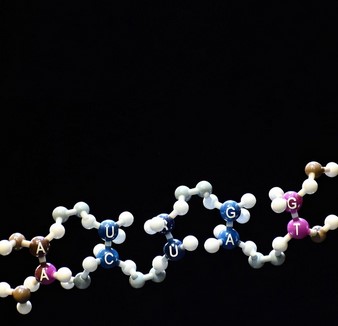
This brings us to the new study highlighted in the Phys Org article and published in Science. Researchers identified a 45-nucleotide RNA molecule, dubbed QT45, that exhibits polymerase activity. In other words, it can help build a copy of itself. One researcher stated that “the complex functions needed for RNA replication… can all be performed by an RNA motif of just 45 nucleotides,” suggesting such molecules may have been more common in the past.
On the surface, this sounds promising for RNA World proponents. A small, self-replicating RNA appears to narrow the gap between chemistry and biology. But the critical question is not whether intelligent scientists can engineer such a molecule. The question is whether unguided natural processes could plausibly generate it.
The article explains that researchers searched through a library of 12 trillion random RNA sequences. They were not passively observing nature. They were actively screening for a specific function- polymerase activity. And after generating massive sequence diversity in a controlled laboratory setting, they applied repetitive rounds of selection to isolate molecules that performed the desired task.
That is not nature. That is design.
Laboratory selection involves foresight, goal-directed screening, and controlled conditions. Scientists defined the functional target, constructed the experimental system, generated variation, and selected success. It demonstrates ingenuity, not spontaneity.
Brian Miller, a physicist at the Center for Science and Culture, rightly pointed out that QT45 was the product of extensive engineering. Generating trillions of sequences, imposing mutations, and applying selection criteria requires intelligence at every step. The success of the experiment highlights the need for guidance. It does not demonstrate blind chemistry.
Even if QT45 does exhibit limited self-replication under carefully optimized lab conditions, it remains far removed from a living system. It does not possess metabolic networks, error-correction systems, membrane integration, or coordinated information processing. Bridging that gulf is not a matter of adding a few nucleotides… it is a leap in organizational complexity.
The excitement surrounding QT45 reflects a broader pattern in origin-of-life research: experimental success in highly controlled environments is interpreted as evidence for natural plausibility. But controlled environments are the very opposite of unguided prebiotic Earth. Every parameter- temperature, pH, concentration, purification- is tuned by human intellect.
In reality, such experiments underscore a different conclusion. When scientists employ massive informational searches, targeted selection, and chemical expertise to produce a minimal functional RNA, they inadvertently illustrate the central role of intelligence in generating biological information.
So the discovery of QT45 does not overturn the Law of Biogenesis. It does not demonstrate that life can emerge from nonlife. If anything, it reinforces the principle that complex, information-bearing systems arise through directed processes. I’d even suggest that the evidence points to an intelligent creator for the origin of life.
If readers want a deeper technical discussion of the chemical and informational challenges involved in self-replicating molecules, I recommend watching the video discussion by James Tour and Rob Stadler.
In the end, the question is not whether intelligent chemists can coax RNA into performing impressive feats. The real question is whether blind chemistry, absent foresight or design, could ever accomplish the same. The QT45 experiment answers that question more clearly than its proponents realize.
 sixdaysblog