There are two competing views of human origins: either we evolved from lifeless matter, or we were created. There really aren’t any other viable alternatives. Either Nature did it, or God did it.
In this article from Sci Tech Daily, the headline asserts that the “Discovery of 8.7-Million-Year-Old Fossil Ape Challenges Long-Accepted Ideas of Human Origins.” Okay, to start with, what are the long-accepted ideas of human origins? I guess that depends on whom one talks to. From a Christian perspective, the long-accepted idea of human origins dates all the way back to the first humans, Adam and Eve, and, later, Moses and the Israelite nation, pointing to humans being created by God on Day Six. However, that idea has more recently been rejected by evolutionists in favor of a naturalistic worldview, claiming that humans evolved from an ape-like ancestor… although there’s no consensus on what part of the world they originated.
One evolutionary camp says humans came out of Africa, while another says Europe. But is either right?
According to this study, a newly discovered fossil named Anadoluvius was recovered in Turkey and is supposedly an ancestor of both humans and apes. The author concludes, “humans may have evolved in Europe and later migrated to Africa approximately 7 to 9 million years ago.”
It’s always fun to analyze the evidence and find out how evolutionists arrive at their conclusions, as I find it has more to do with faith than science.
Consider, what scientists found was a “partial cranium” and “includes most of the facial structure and the front part of the brain case.” There are no limb bones, yet, based on evolutionary assumptions, researchers concluded its diet consisted of roots and rhizomes, it weighted about 50-60 kg, lived in a forest, spent most of the day on the ground, and its ancestors migrated into Africa due to climate change and gave rise to chimps, bonobos, gorillas and humans. Wow, all that based on an incomplete, fragmented fossil? Well, other evidence includes a variety of animals buried with it (including carnivores), as well as geological data and a computer program designed to calculate evolutionary relationships. Yes, that’s right, a program designed to accept evolution.
In addition, researchers considered other fossil apes, such as Ouranopithecus from Greece, and Graecopithecus from Bulgaria. Based on these fossils, they conclude there was a “diverse” population of apes in Europe that evolved into modern humans. And despite their fragmentary nature, they were considered the “best-preserved specimens,” making it hard to refute their speculatory, evolutionary conclusions.
Interestingly, the scientific consensus was once the Out-of-Africa model, but now that’s changing. This goes to demonstrate the unreliable nature of scientific consensus, which many people use as evidence to support their favorite scientific theories. But when the consensus changes, we learn that many scientific theories, which were once held to be true, were never true in the first place.
It’s also helpful to note some of the deceptive evolutionary tactics employed in this article. For instance, the author begins with a statement of fact, claiming, “Anadoluvius existed 9 million years ago and is ancestral to living African apes and humans.” The truth is, this statement is not a fact. It cannot be proven, but must be accepted by faith because the evidence is based upon unprovable assumptions and cannot be substantiated. For one thing, the researchers admit their claims are just a hypothesis based upon their own interpretations and opinions. Further, the lead researcher, Professor David Bergun from the University of Toronto said, “This new evidence supports the hypothesis that hominines originated in Europe and dispersed into Africa along with many other mammals between nine and seven million years ago, though it does not definitively prove it [emphasis mine]. For that, we need to find more fossils from Europe and Africa between eight and seven million years old to establish a definitive connection between the two groups.”
Well, I’m glad he admits his hypothesis has not been definitively proven and requires more evidence, but his comment is found in the last sentence, at the end of the article, and I’d wager most of the people reading it won’t catch the disclaimer, instead accepting that his evolutionary claims are definitive.
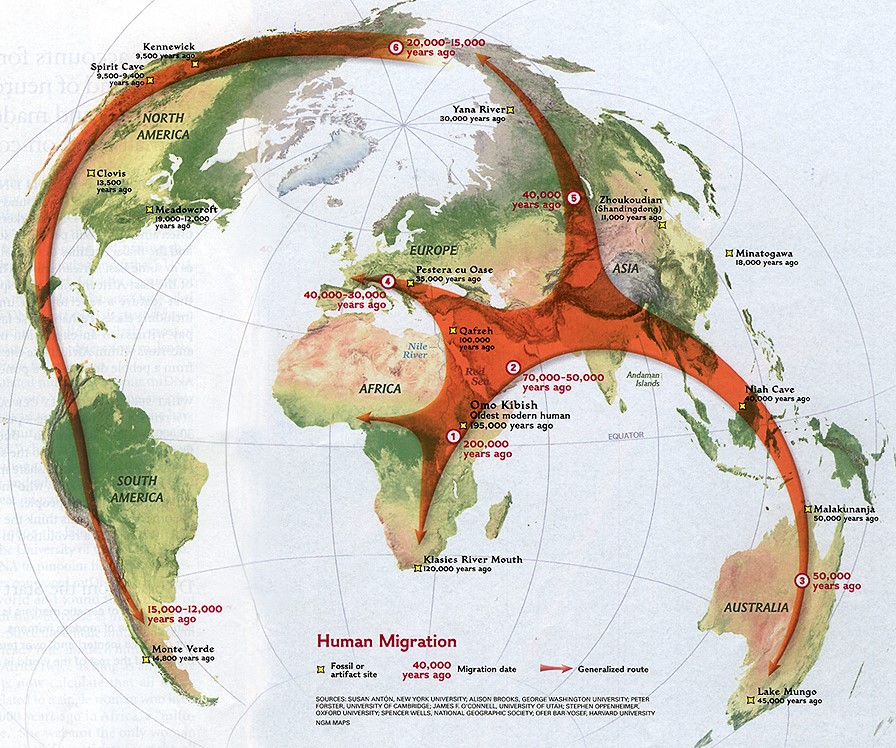
Lastly, I’d like to provide evidence that both of these evolutionary theories are incorrect. In fact, based upon current genetic evidence, humans originated somewhere in the Middle East and spread out around the world. This scientific evidence supports the Bible, suggesting people congregated in the Middle East, and then dispersed around the world. This closely matches what we’d expect as Noah and his family came off the ark and their ancestors settled around Babel. I don’t think it’s coincidence that science matches up best with the Bible, rather than evolutionary theory.
 sixdaysblog
You may be in danger of a fallacy. The extreme unlikeliness of One option does not make the other one true or any more likely. Perhaps… “I don’t know” is best when we really dont know, but can only Believe. 🙂
Thank you, I appreciate your concern. But I hope I avoided any fallacy. I agree that the extreme unlikeliness of one option does not make the other one true or any more likely. But what does the evidence suggest? What is it pointing to? Although new evidence could override the human migration map, which is based on genetic data from around the world, the evidence suggests exactly what I mentioned, namely that people originated somewhere in the Middle East and spread out around the world. I think the genetic evidence is better than evolutionary speculation that may not have any connection to reality.
On the contrary, don’t you agree there were many fallacies presented in the article? Instead of presenting their findings as fact, perhaps they should have said, “I don’t know.”