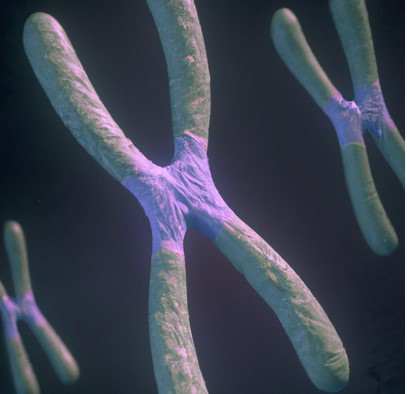
According to this evolutionary article from The Scientist, centromeres mutate more rapidly than expected. So what are the implications, and what does it have to do with evolution? Rather than directly recapping the article, here are six summary points. But first, what is a centromere? Simply put, centromeres work in chromosome duplication during cell division. A chromosome has two chromatids, and these chromatids are joined together in a region called a centromere. Okay, let’s go.
1: Complexity. The article states, “As a chromosome duplicates, the centromeres connect the old and new copies in an X shape. This union provides the mitotic spindle a place to latch onto so that [emphasis mine] it can tug the two chromosomes apart during cell division. Without centromeres, cells would fail to evenly separate their chromosomes.” Most evolutionists don’t pay respect to how complicated this process is. How did all this come about in the first place? This sort of thing doesn’t occur spontaneously today, so how did it happen in the past? What caused that union to exist? Why should a mitotic spindle exist, and how would it know when and where to latch onto, and what communication causes it to tug the chromosomes apart perfectly? Notice that these evolutionists speak as if there’s a purpose behind all this, yet evolution inherently implies there is no purpose. Could there be a paradox?
2: Consensus: According to geneticist Glennis Logsdon, “We had one consensus sequence that we used for all centromeres, and we thought, ‘this is all we need to know,’” This is but one problem with consensus… it inhibits science, and is often wrong. In this case, it was wrongly assumed that centromeres conserve sequences and structures, but now they’ve learned that centromeres are highly plastic, meaning they mutate rapidly. The consensus sequence was based on evolutionary reasoning, which is problematic. The damage has been done. This was an area neglected by scientists because they didn’t think it was an area worth researching. Afterall, they thought they knew everything they needed to know.
3: Mutations: Mutations are thought to be the key to evolution. Somehow evolutionists think mutations are enough to produce feathers, scales, fur, limbs, lungs, a nervous system, etc. Yet none of this has ever been observed in nature. It’s simply assumed because that’s what evolution requires. But this article makes it clear that mutations lead to defects, such as Down Syndrome, tumors, cancer, aging and disease. Nowhere do we see mutations leading to increased complexity or new novel body plans as would be required if all organisms are related to a single common ancestor.
4: Surprise: Researchers were surprised at the results of the study. According to molecular biologist Yamini Dalal, “It was completely unexpected to me.” I’d suggest the reason why they’re surprised is because of their assumptions, which are evolutionary based, not science based. Science encourages skepticism and research while evolution inhibits it. Why study something if you already have all the answers?
5: Failed evolutionary prediction: Successful predictions are said to be the sign of a successful theory. Thus a failed prediction is harmful to a theory. It was wrongly assumed that centromeres had conserved sequences and structures because of their vital role dividing up the DNA. It was assumed that “biological structures with essential functions are evolutionary conserved.” But these researchers found that centromeres are not as rigid as expected, meaning there’s a great deal of diversity across different people groups, including those of European descent. But instead of being skeptical of evolution, evolutionists simply regroup and change course, and that’s what they’ve done here. With their evolutionary assumptions still in place, these researchers compared human centromeres with chimps, macaques and orangutans, and once they were all sequenced, they “estimated how rapidly they evolved.” Notice that they don’t question IF evolution occurred because it’s already assumed. Therefore, based on that assumption, they found that these regions mutated more than four times faster other regions of the genome. But the author of this article points to a paradox summed up by Dalal: “They are fast evolving, and no one really knows why.” The problem is that centromeres “flout” evolutionary rules.
6: Religiousness: There’s a religious faith associated with evolutionism, and that is demonstrated in this article. There’s no questioning evolution despite its failed predictions. It’s accepted as ultimate truth. Therefore, if there’s a paradox, it’s brushed aside and they move on. Eventually it will become part of evolutionary doctrine.
I’d suggest these six points are good reasons to be skeptical of evolution, if not reject it altogether. A better explanation for these discoveries is found in God’s creation as described in Genesis. This better explains the existence of complex functions at the molecular level and their purpose. So these results are not surprising, as creationists are always pressing to learn more about the genetic code in all organisms. Genetics is a prime field that shouts of a creator.
 sixdaysblog
From the perspective of the human, cancer is indeed a defect. But wouldn’t you say that from the perspective of the cancer cell, it has actually mutated to increase its own ability to survive and reproduce? In other words, evolution.
No, I wouldn’t say that. I don’t think cancer has a perspective. It’s my understanding that evolutionists would consider cancer to be non-thinking (as it doesn’t have a brain), so it’s not consciously trying to survive. Sure, it mutates, but it’s not evolving in the sense that it’s becoming a new lifeform or organism. It’s not producing new genetic instructions that code for a mouth or lungs or a heart. Cancer usually happens when the cells don’t stop reproducing when they should. That’s not evolution. That’s more like a broken regulatory switch. But how did the regulation get there in the first place? That’s the real question as to whether there’s evolution or not.