I love this take against the Big Bang theory. Scientists have been critical of it for decades, but there’s never been another theory worthy of replacing it, so it persists. Nonetheless, more and more scientists are catching on and becoming vocal. This is a good thing.
Here we have a team of astronomers calling out some of the theory’s failed predictions. Using the James Webb Telescope, they have observed that some of the oldest galaxies are far brighter and heavier than predicted. Failed predictions point to weaknesses in a theory and is a sign that it may be wrong.
The standard Big Bang model predicts the existence of dark matter, which is a mysterious substance inferred from the gravitational pull on visible matter, such as stars and galaxies. But the problem is, there’s no direct evidence for dark matter at all. Despite the enormous costs, all experiments have utterly failed, even though the material is thought to make up about 27 percent of the universe.
According to a new study published in The Astrophysical Journal, “What the theory of dark matter predicted is not what we see.” In fact, says astrophysicist Stacy McGaugh, “The bottom line is, ‘I told you so.’ I was raised to think that saying that was rude, but that’s the whole point of the scientific method: Make predictions and then check which come true.”
I love it! And it’s true. Scientists have been pointing to holes in the theory for years, but to no avail. So it’s about time someone said, “I told you so.”
Now these researchers are proposing an alternate model known as modified Newtonian dynamics (MOND). This model has made some successful predictions, such as the size and brightness of the earliest galaxies, which is good, but it still doesn’t explain other cosmological phenomena.
I’m not a proponent of either model. As a creationist, I believe God created the heavens and earth is six ordinary days relatively recently. And I think that’s why secular astrophysicists are having difficulty pinning down a naturalistic cosmology. Naturalistic methods don’t have much to offer when it comes to describing a supernatural event. These are two opposing worldviews. Secular scientists could never consider that the universe was designed and created by God, as that would violate their worldview. But if the Bible is true, then that would have significant consequences on cosmology, and that would explain why the right secular model is so elusive.
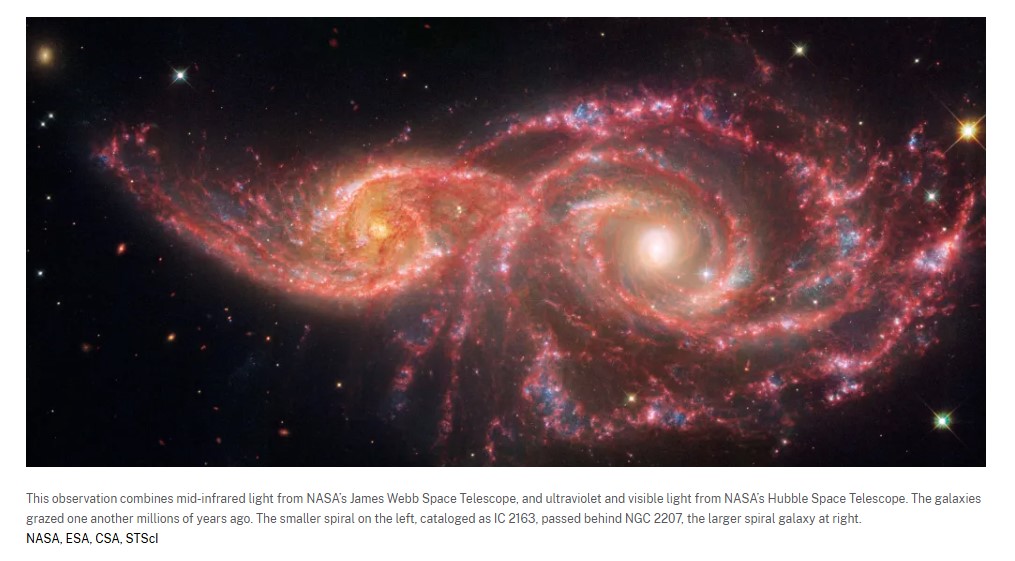
Note: The above photo is a random NASA photo and not part of the study.
 sixdaysblog
The whole thing is a scam. Right from those pictures you posted. First, there is no such pictures. They create the pinks and yellows to represent information received in from a radio telescope OR Hubble.
Imagine the width of such a thing providing so much energy and light those images fool us. Gas does not produce so much light over trillions of miles so concentrated and the size of that would be off the chart.
—
So if they say they are brighter then this Idea of telling how far they are away because of their brightness or wavelength is bogus.
The ONLY sure thing we know is, what ever is happening its fairly static because next year we can look back and find the same thing. So much for huge inflation or implosion to make a universe 90 billion light years wide in just 14 billion years. Anything expanding 3 times the speed of light would not send back images at all.
So Im not sure how to re-interpret everything being flooded with false images and the scam.
Thanks for your response.
I have no idea of it’s a scam. I have no reason to think it is. The image is straight from the NASA website, and it’s just a random photo, so I’m sure they enhanced it before publishing it. According to the information in the caption, they combined mid-infrared light with ultraviolet visible light from both the Webb and Hubble telescopes. I should have made that a little clearer for the photo I used, which wasn’t part of the study, and the study itself didn’t incorporate any photos.
Anyway, however far away these galaxies are is irrelevant to me. I believe the light from these galaxies can be seen in real time. Secular scientists believe the light received by the Webb telescope left those galaxies 13-14 billion years ago, but I subscribe to the anisotropic synchrony convention which allows light to travel instantaneously. Thus the light we see is seen in real time.
And my main point is that secular models have problems because they’re starting with the wrong premise. The universe was created by God- probably 6-7 thousand years ago, not 13.8 billion years ago by naturalistic processes.
https://answersresearchjournal.org/anisotropic-synchrony-distant-starlight/
Considering the distance and that the Images are generally from a Radio Telescope and not from Hubble, its fairly obvious its a scam. The width of such a gas cloud in the pictures you feature show how nuts it all is. To think Gas is giving off light like that for hundreds of millions of years. Its total nonsense.
—
And if the Universe is 90 billion light years wide and only 14 billion years old, then the matter and forming stars are or were travelling 3 times the speed of light to get out that far and every bit in between. So we couldn’t see anything from things moving away from us in the light spectrum because the Doppler effect. In fact it would be so bad all you would get is light shining toward us but because it came from a star travelling away from us 3 times the speed of light, that photon would be moving away from us, not visible to Hubble.
—
So anything Hubble provides is of stars barely moving in relation to us, blowing up the whole big bang theory.