Here’s an article from Discover Magazine proclaiming that pig – boar hybrids in Fukushima are “evolving rapidly.” But is that really the case?
The word evolution has a wide range of definitions. It doesn’t just refer to the belief that fish evolved into amphibians, or apes into humans, or that all living things share a single common ancestor. No. Today, the term is often used to describe any observed genetic change in offspring. Any mutation or variation in DNA can be labeled “evolution,” even if the animal has not developed a new, complex body plan or transformed into a different kind of animal.
The terms ‘microevolution’ and ‘macroevolution’ don’t help either because both imply that evolution is real when that’s the very point under dispute.
Of course this muddies the water. When people speak of evolution, are they referring to changes we can directly observe, or to large-scale evolutionary claims that cannot be observed and must be inferred from interpretation and believed by faith? We cannot observe fossils evolving, but we can observe variation within animal kinds- such as wolves, dogs, and coyotes.
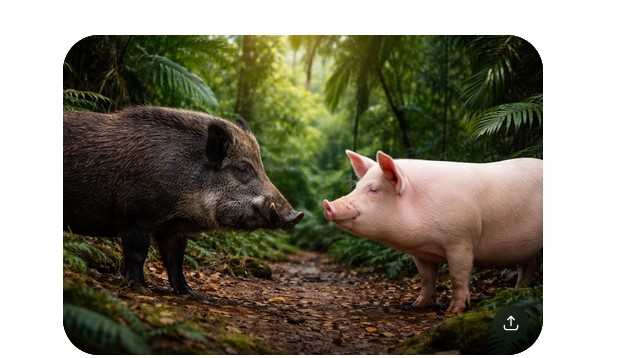
So which kind of evolution is this article promoting? It’s all about observable changes within the pig or hog kind. After the Fukushima nuclear accident, animals within the evacuation zone experienced unusual ecological pressures, and the study focused on the interbreeding of wild boars and domestic pigs.
Researchers found that hybrid offspring inherited the female domestic pig’s ability to breed year-round. This trait caused the population to reproduce more rapidly than wild boar typically would. However, rather than preserving domestic pig genetics as scientists expected, the female pig’s repeated breeding with wild boar diluted pig DNA faster than predicted.
It is worth noting when scientific predictions fail, especially since evolutionary theory often emphasizes its predictive power. In this case, researchers expected rapid reproduction to maintain pig genetic influence, but the opposite occurred, demonstrating that their population genetics models did not fully predict the outcome. When predictions do not match outcomes, it is reasonable to question the assumptions behind those predictions.
Although I did not personally make a prediction beforehand, the results themselves are not surprising. If boar genetics are better suited for survival in the wild, then over time those traits will dominate. Domestic pigs are adapted for farm life, where humans provide food, shelter, and protection. In contrast, wild boars are adapted for foraging, avoiding predators, and surviving harsh conditions. It is therefore logical that hybrids living in the wild would increasingly preserve the DNA of boar over domestic pigs. The preservation of pig DNA would be a disadvantage.
Researchers noted that it remains unclear what drove these genetic shifts. However, the process can be explained by known principles of population genetics: differential survival, reproductive success, and environmental selection pressures acting on existing genetic variation. The hybrid population did not acquire any novel, complex body plans; rather, it experienced sorting and reshuffling of pre-existing alleles through hybridization and selection.
This distinction is critical. What we observe is not the emergence of new biological structures or novel genetic systems, but the redistribution of existing genetic variation within the broader pig–boar gene pool. This is consistent with normal genetics, not the origin of new kinds of organisms.
I’d suggest that this is evidence for a creator- an intelligent designer who programmed the DNA in all animals so that they could fulfill their God-given mandate to fill the earth. God blessed them with genetic instructions that would allow this to happen. Living organisms appear equipped with built-in genetic flexibility that allows them to adapt to changing conditions and environmental pressures. Such adaptability would enable animals to spread, survive, and fill ecological niches across the earth under a wide range of conditions.
By contrast, if evolution were purely an unguided, natural process, then why should DNA repeatedly produce functional, beneficial outcomes that help organisms survive and thrive?
What happened to these pig–boar hybrids may be surprising to researchers working within an evolutionary framework, but it is not surprising from a creationist perspective. If living organisms were designed by God with robust and flexible genetic systems, then we would expect exactly this kind of outcome: variation within a kind, environmental sorting of traits, and the continued success of the animal in its habitat.
In other words, the Fukushima hybrids do not demonstrate the evolution of a new kind of creature. They instead illustrate variation, hybridization, and natural selection operating within the boundaries of DNA- something that is observable. Referring to this as an example of evolution ignores the boundaries of genetics. It represents a failure to recognize the distinction between normal genetic processes and the ability to produce complex, novel body plans, or change boars and pigs into a new kind of animal. The boars and pigs remain part of the Suidae family. They haven’t evolved into anything else.
 sixdaysblog