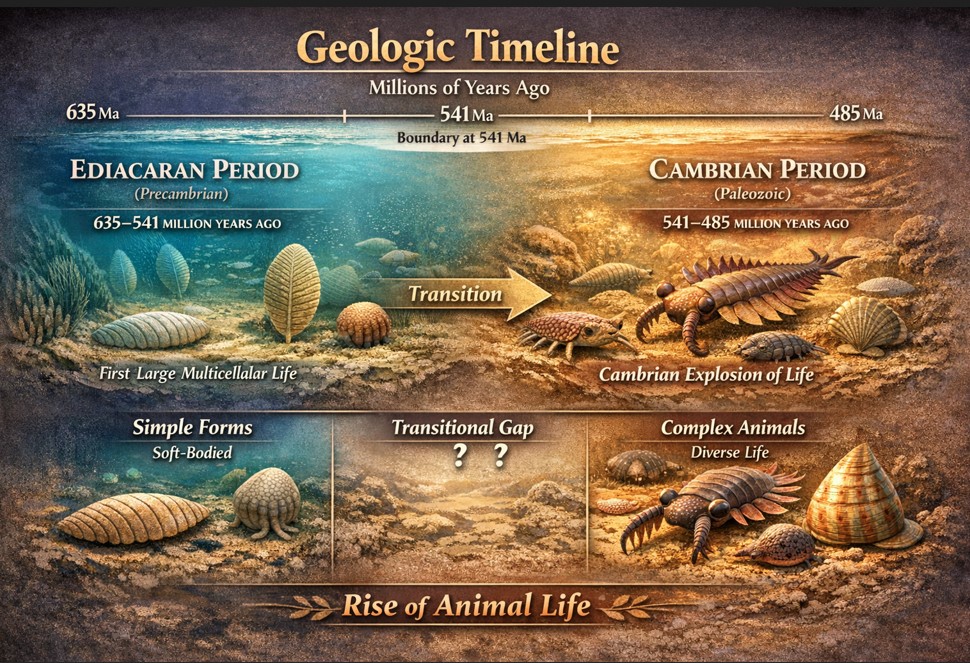
The Cambrian Explosion has always been a thorn in the side for evolutionists. It is known for the sudden appearance of nearly all the major animal phyla in the fossil record. Complex organisms never seen before- with shells, appendages and eyes, come out of nowhere. It’s been described as an “incredible burst of life that reshaped our planet” and marks the rapid diversification of new body plans. Evolutionists admit that this sudden burst of life is a challenge to “traditional views of gradual evolutionary change.”
This article from Discover Magazine is intriguing because it seeks to overcome those challenges. But if we examine the evidence and facts a little closer, what we find is a case study in how the science of evolutionary theory evolves over time.
The headline proclaims, “539-Million-Year-Old Ediacaran Fossils Push Complex Animal Life Back 4 Million Years.” Okay, the first thing we should note is that, according to secular science, 539 million-years in the past does not include the Ediacaran Period. The Cambrian Explosion began 541 million-years ago, which is when the Ediacaran ended. So right from the start we have a problem. The study in question is presenting a 539-million-year-old fossil as evidence to push back the origin of animals “millions of years” before the Cambrian explosion.
I’ve seen this dating game deployed countless times, and it’s important to understand how it works. Firstly, evolutionists often insist that all scientists are in complete agreement with all of evolutionary theory all the time, and such consensus is their proof. To them, no true scientist disagrees. There’s complete unity, and no disagreement. But to the discerning, that cannot be true because science can’t progress unless someone disagrees. If nobody challenged the scientific beliefs of the past, we’d still be living in the dark ages where the educated believed in spontaneous generation. The point being is that consensus is harmful to scientific progress and isn’t evidence for evolution. If anyone believes in evolution because everyone else believes it, that’s a problem. Facts and truth don’t rely upon consensus.
Secondly, the geological periods have been assigned certain ages, but those ages are flexible, being changed from time-to-time. This leads us to question how reliable these dates are.
The study states that the Cambrian Explosion began 535 million-years ago and that “fossils from southwest China were turning up in rocks older than that timeline allowed. They were expected to be simple algae, but some preserved complex features. Then one revealed a mouth and a body built to feed, showing these animals were already around millions of years ago.”
So we’re being told that complex features were showing up in the fossil record long before the Cambrian Explosion. To them, this explains why so many body plans seem to have appeared abruptly. These animals were “invisible,” but, thanks to the discovery of these new fossils, the mystery has been solved! The Cambrian Explosion was just an illusion.
The study’s lead author, Gaorong Li, said, “It is both surprising and deeply rewarding. For a long time, this has been one of the most fundamental questions in evolutionary paleontology: where are the body fossils of the animals that should have existed before the Cambrian?” Li went on to say, “So instead of thinking of the Cambrian Explosion as a completely sudden appearance of complex animals, we may need to see it more as the ecological and evolutionary expansion of animals that had deeper roots in the late Ediacaran.”
So they’ve concluded that the Cambrian Explosion doesn’t mark the origin of these body plans, but only their visibility in the fossil record.
But here’s the thing… according to other evolutionary sources, the Cambrian Explosion began 570 million-years ago. Therefore, if we accept these earlier dates for the Cambrian Explosion, the study doesn’t make the problem go away.
All this means that the Cambrian Explosion is very real, and it’s still a mystery where all those new body plans came from. Where is the evolution? If their claim is that evolution is invisible, then why should we believe it? Is it okay if we disbelieve in evolution, or not accept it?
Interestingly, while they want to fit these new discoveries into an evolutionary tree of life, they admit that a number of these new organisms don’t fit into any known animal groups and have unexpected structural arrangements, which makes the puzzle even more complex.
The final issue concerns dating techniques in general. We’re told that dating techniques can’t be questioned because they’ve been confirmed by other dating techniques. But if that were true, then the dates should never be changed or altered, right? Because there would be no need to. But the fact that geologic time periods vary from source to source is evidence that the dating techniques cannot be reliably trusted in the first place.
In conclusion, the Cambrian Explosion remains a problem for evolution. Moving the problem back a few million years does not explain it. It simply relocates it. Thus, I’d propose a better solution for the sudden appearance of new body plans and animal phyla. According to Genesis 1:11-25, God created animals according to their various kinds. For those willing to accept it, the Bible presents a better explanation for origins than the theory of evolution.