Here’s an article from the Smithsonian Magazine on the James Webb Telescope, and it serves as a case study on the ever-changing nature of science.
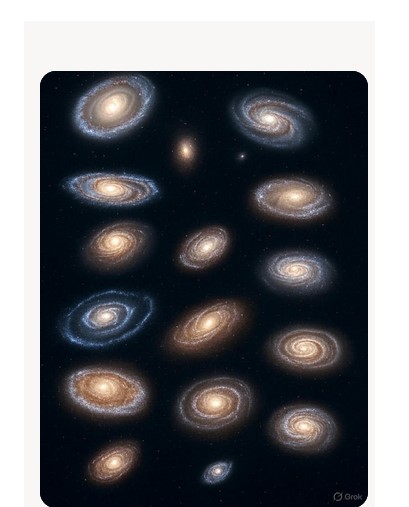
Consider, it has been discovered that most galaxies rotate clockwise, and many astronomers are puzzled. But why are they puzzled? As it turns out, this preferred direction isn’t supposed to exist. According to modern astronomy, the direction of spin should be evenly distributed. They believe universe should look the same everywhere we look.
This doesn’t bode well for secular cosmology. Accurate predictions are the benchmark of a good theory, so when predictions are demonstrably wrong, it damages the theory. And that’s why scientists are confused.
Astronomers propose two reasons why two-thirds of galaxies rotate clockwise. Either we live in a universe that exists inside of a black hole which exists inside of another universe… or scientists have been measuring the expansion of the universe incorrectly.
I’m highly skeptical of the first explanation, as there’s no practical way to confirm such an odd idea. It’s nothing more than a rescue agent for the express purpose of propping up a secular ideology. It allows one to maintain the belief that the universe and life can exist without God.
But the second explanation seems more logical and most likely. It’s okay to admit that scientists get things wrong… more often than we think, particularly when it comes to the past. There’s nothing wrong with such an admission. Humans are imperfect. So that should be expected. No one was there to witness the birth of the universe. Therefore, if these scientists don’t believe in God, or don’t wish to acknowledge a supernatural creation over six days (as presented in Genesis), then they must invent clever stories, and that’s what is going on.
Rather than our universe existing inside a black hole, however, it could be that our distance measurements for deep space are incorrect and must be recalibrated. If this is true, then scientists think we may not be capturing all the galaxies in our current samples, and a recalibration could discover that galaxies do rotate evenly once a corrected survey is completed. This is reasonable, and, theoretically, it would validate the self-correcting nature of science that many profess in.
But who’s to say the next calibration is accurate? That’s the rub. The new calibration could be wrong too, but touted as fact because it delivered the desired results. How would we know for certain? We couldn’t. We’d just have to trust the same science that was wrong in the first place.
Honestly, I’m not wedded to a preferred direction, although that would be cool if one existed. But the point is that scientists are flawed and have biases, and they use those biases to do their science. If that weren’t the case, then they wouldn’t come up with the universe inside of a black hole idea.
So we have a battle of worldviews. It’s not the science. It’s the scientists and the unprovable assumptions and beliefs they adhere to that drive the science. Either God created the universe as he said, or it happened naturally, without any God or god(s). The secular worldview keeps missing the mark and is in constant need of corrections. Creationists use science to explain a young universe, and I’d argue that the creation account in Genesis offers the best worldview. Christians don’t need to adopt a secular worldview, and we shouldn’t. We can maintain a biblical worldview without compromising, and this article is a prime example why.