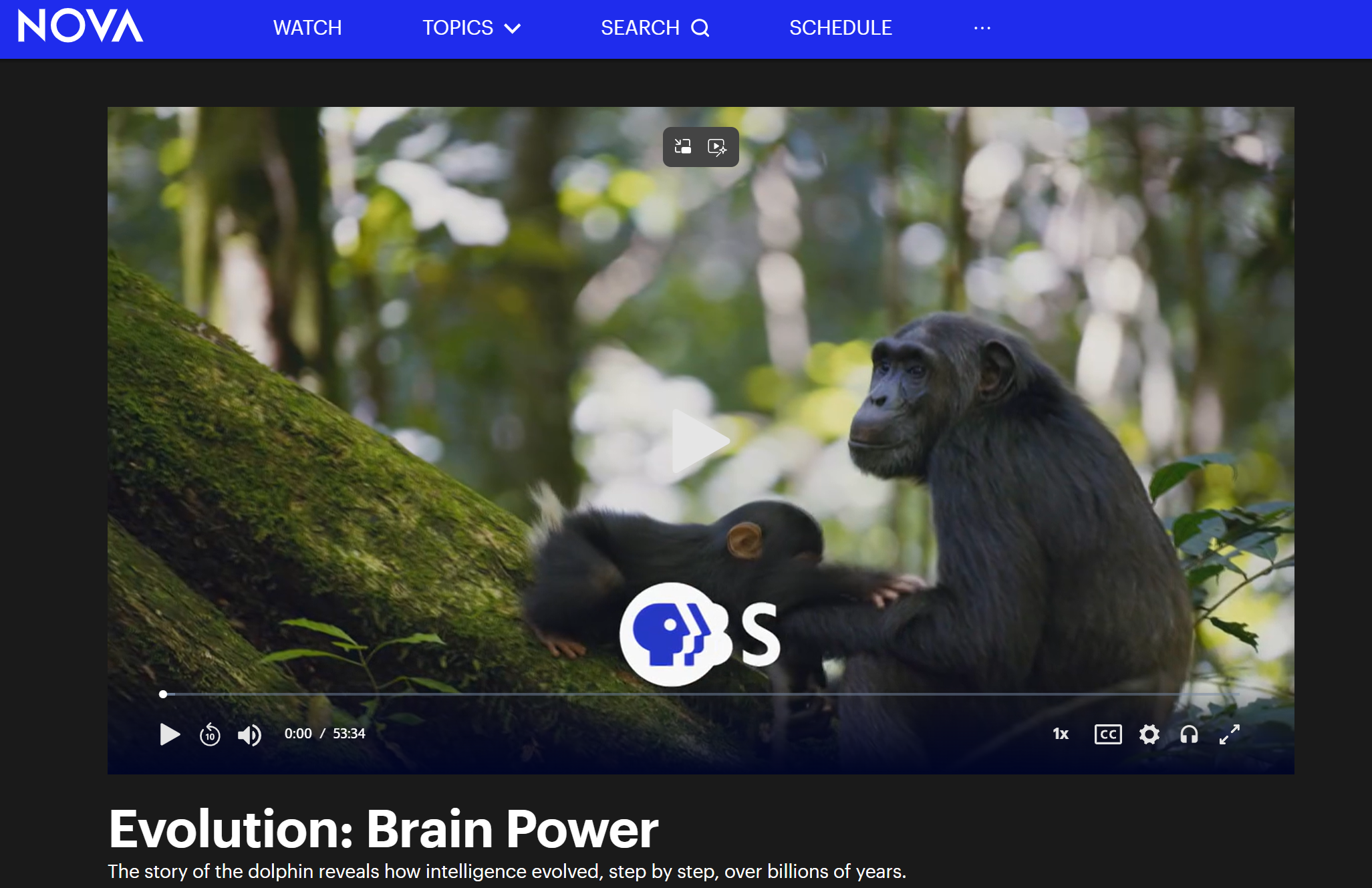
My previous article teased a five-part series on evolution by Nova on PBS. This post focuses on Part 1: Brain Power, and it follows the dolphin’s supposed evolutionary history over billions of years. I call it “supposed” because, as a creationist, I reject evolutionary theory as bad science. There’s simply no good evidence to support it.
To be clear, there is no real evidence for evolution in this episode. It’s a propaganda piece. Evolution is assumed, and that’s what serves in place of evidence. If one simply believes evolution, then an evolutionist may find this episode compelling. But those who question evolution should be able to confidently reject evolution.
The episode begins by telling us that the brain is the most “enigmatic structure in all of biology.” In other words, evolutionists admit that the brain is mysterious, puzzling, and difficult to understand. They refer to it as daunting and say it’s comparable to a black box. This is an honest admission that should never be forgotten.
Nonetheless, they profess hope, claiming that “Scientists are beginning to understand how they evolve”. But I challenge this notion as circular reasoning. Despite the improbabilities, evolution is not questioned. As we’ll see, all observations that conflict with evolution are interpreted as evidence for evolution.
One scientist states, “I think intelligence is perhaps unavoidable in terms of evolution.” Unavoidable? This statement is at odds with what other evolutionists have told me about evolution. I’ve been told that evolution doesn’t have to happen at all. It’s not inevitable. To them, this explains why we don’t see any evolution in the fossil record when comparing living animals to their ancestors.
But if intelligence is unavoidable, then we should ask why no animal has ever built a single hospital or sent one of their kind to the moon and back. If intelligence is unavoidable, then we should see animals with humanlike intelligence everywhere. But we don’t.
Evolutionists point to vision as a driving mechanism for brain evolution. They start with a single cell, then show an imaginary organism with an eye spot and assume evolution.
However, if this scenario actually happened, then we should observe this today. After all, evolution doesn’t stop working the moment we start watching, right? So scientists should conduct experiments to show how vision causes the brain to evolve into something greater, more powerful. But they don’t.
They say that vision leads evolution in a direction of greater complexity, yet evolutionists also tell us that evolution is not directional. Which is it? They can’t have it both ways. If both are true, then evolution can’t be falsified, which means it’s not a real theory. A good theory must be falsifiable.
In reality, if evolution were true, then vision couldn’t drive evolution because chemistry doesn’t possess intelligence. It behaves according to its properties. No intelligent source guides it in any direction. So it doesn’t matter if a new organ would be beneficial. It wouldn’t know that in advance. The best evolution can offer is the idea that some mutations must have been useful, and somehow they were preserved in the genome in the right place and time so that they could potentially be improved upon over time, and those improvements just so happen to also lead, incrementally, over the course of many generations, to intelligence by some stroke of luck.
Luck, therefore, is why scientists are puzzled… because intelligence doesn’t make sense from a truly evolutionary perspective. But since the alternative- God’s special creation- is actively denied, luck must be embraced at all costs. Therefore, evolutionists must find ways to make evolution more appealing, which is why they invent driving forces as a mechanism… even when those mechanisms violate their own rules.
Next they speak of “chance events” that “rewire” ancient brains. This alone refutes evolution. Intelligence is highly complex, yet evolutionists, knowing this, call it simple. They cannot provide a coherent, verifiable explanation for intelligence, let alone how intelligence was rewired for greater intelligence without harming the organism.
Evolutionists claim that “Brains are driven to expand and become more and more and more elaborated.” I see no evidence of this. What verifiable evidence do they offer? None.
I’m truly shocked at the lack of evidence in this program. We’re given nothing but assertions and storytelling. For instance, the narrator took us back in time, billions of years ago, as if this were possible, and we’re meant to blindly accept the visualizations as factual.
The narrator introduced “simple cells”, as if cells are simple (they’re not). Then they assert that, billions of years ago, a simple process allowed an organism to sense light. After all, if an organism can sense light, they can react to it. However, if that organism could survive without the ability to sense light in the first place, then there’s no reason to evolve that ability. The organism would be wasting energy needed elsewhere. Further, if that organism truly needed to sense light, such a process would take millions of years, so the organism would go extinct before evolving this ability.
The narrator explains why an organism would benefit from sensing light and how these abilities would confer an advantage, as if that is relevant. It’s not. The ability to fly would give me a tremendous evolutionary advantage, but that’s not evidence for evolution.
They introduce a molecule called retinal; it can change shape after absorbing a light photon, so an organism with retinal can react to light. Then we’re told, “this ability to sense light with retinal will change everything. Once retinal is in play, we have a molecule which allows early cells to detect light.” But they provide no evidence for the origin of retinal. It is simply asserted, and that is treated as evidence. Then, since retinal now exists, it “leads to more complex behavior and possibly the development of the brain itself.” Wow! See how that works? Make an assertion, assume evolution and run with it.
We’re told, “Over the next two-and-a-half billion years, life diversifies from single celled to multicellular forms.” Oh, really? Is that diversification observable, or is it assumed?
Without evidence they claim that the first nervous system arose. Then an unidentified, AI generated organism is introduced, and they say that simple eye spots with primitive parts developed and improved over time. Evolution is so simple when they keep repeating the term “simple.” But I don’t think evolutionists understand what “simple” means. We don’t see simple evolutionary advantages arising today, so it can’t be all that simple.
Is there any scientist who can make a single-celled or multi-celled organism to acquire light-sensitive eyespots comparable to flatworms, leeches, caterpillars? If this were possible, then evolutionists should show us how simple the process is. Unfortunately, evolutionists hide behind millions of years, so their claims are unverifiable.
These evolutionists insist that all these “early” behaviors and reactions happened without thought, but they don’t explain where the programming to react came from. How does the organism know to go toward the light or away from it? When to stop or go? How is orientation obtained? Again, evolutionists claim this is simple, but it’s not. How does the organism move? How is the behavior programmed? Evolutionists downplay complexity, suggesting there’s nothing to see here. Simple, simple, simple.
More assumptions are made as this flat, imaginary organism suddenly has curved eyespots (magic!). Mutations are usually harmful, but it’s assumed that a series of beneficial mutations must have- somehow- improved the organism’s ability to sense light, and they call it a “superpower”!
Interestingly, the narrator states, “Little dimples like these ones may well have been the first simple eyes.” But then admits, “It’s an intriguing theory, but one for which there is no fossil evidence.” But evidence won’t stop evolutionists. No, in this case they look for “clues” by studying the velvet worm’s “simple” eyes and say this means the ancestor of dolphins saw blurry images! No evidence. Just circular reasoning.
Then we get lenses and a retina, and, finally, “one of the most complex instruments evolution has ever produced.” Right. Simple, simple, simple, simple… outrageously complex! They just appear. Magic! Evolution requires one thing… faith.
It’s said that the first “tangible evidence” of complex eyes comes from the Cambrian, but no evidence is provided for their origin.
We’re told that “Vision is a lot of information”, and that is true, but evolutionists can’t tell us where information came from, how it’s translated, or how instructions get carried out.
To explain complexity, a story is told about a virus. Not just any virus… a “sophisticated” one, called a retrovirus, and it’s described as “cunning”. If the retrovirus invades the egg or sperm, its DNA may be incorporated into the offspring and improve the brain- Tada! But the funny thing is, we’re told that this “rare” event happened “many times across several vertebrate lineages.” Call me skeptical. But that’s not all. Evolution found a solution to improving brain function by increasing the speed of brain conduction, which allowed for consciousness and a “turbocharged nervous system”. Right. More magic.
Eventually they get to whale evolution, claiming that a small, hoofed mammal the size of a cat evolved into the great whales and dolphins of today. No evidence is provided. Just a few fossils and a cartoon. They claim with all seriousness that Indohyus might have walked on the bottom of rivers and streams until it became fully aquatic, complete with flukes, flippers and a nose on its back… all in a very short evolutionary timeline.
There’s no true substance to the program. Just imagination and storytelling.