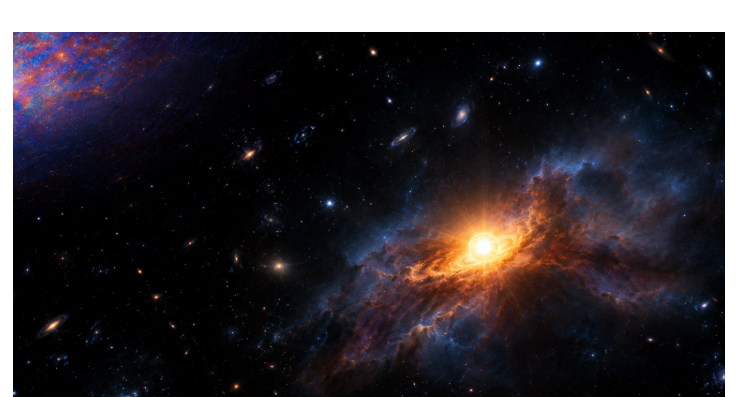
Being that this is World Space Week, here’s a post about space.
I enjoy perusing science headlines from various sources, and one of the things I often notice is when scientists get the facts wrong. Now this doesn’t mean that science is worthless. It just means we must be aware of its limitations. Facts and evidence must be interpreted according to worldviews, and the following article is a prime example.
The headline announces that things didn’t happen the way many scientists expected. And one reason why this is important to be aware of is because secular scientists- those who accept secular sources over biblical sources- often insist that their naturalistic claims, particularly about origins, are facts and not open to challenge. However, secular sources expose the weakness of such thinking. Many times facts amount to little more than a belief.
In this case we learn from Science Daily that “The early universe wasn’t nearly as pristine as scientists thought.”
Instead of accepting that God created the universe in six days as the Bible says (Exodus 20:11), secular scientists came up with their own naturalistic cosmology to explain how the universe came into existence without God. And their model states that the earliest galaxies must have been pristine- meaning that they consisted mainly of elements created by the Big Bang, like hydrogen and helium.
But one problem with this cosmology is that it is a theory and cannot be proven. Therefore, one must choose to believe it by faith.
For some time, there was no way to observe the most distant galaxies and stars. However, with the advent of more powerful telescopes, scientists believe they can look back in time to when the earliest galaxies existed… but they don’t find what their cosmological theory predicts. According to researcher Yongda Zhu, “We observed that heavy elements escaped from galaxies very, very early in cosmic time”. This was unexpected. Therefore, they now believe these heavier elements were “possibly seeding other galaxies” with carbon and oxygen when the stars exploded, and this, in turn, eventually allowed for the chemistry of life on earth.
So, according to data from the James Webb Telescope, the seeding process happened much faster than expected.
Another mystery mentioned in the article are hypothetical stars referred to as Population III stars. Scientists are unable to find such first-generation stars, which should have existed if their theory is correct. But these “pristine” stars and galaxies don’t seem to exist.
Of course, the article provides an explanation: “If galaxies were already enriching nearby space only 500 million years after the Big Bang, truly pristine gas may have disappeared quickly.” This means that they don’t need verification of their theory… just an explanation that cannot be disproven.
To be fair, other explanations could be offered, but the fact of the matter is that it’s impossible to know for certain which explanation- if any- is correct. For all we know, the best explanation might be one that isn’t permitted by secular science- the idea that God created the universe, just as the Bible says.
Nonetheless, the theory offered remains powerful and effective because it cannot be disproven. All that is required is a clever explanation that will be accepted by the consensus. And the more who buy into it, the more effective it is.
However, if the Bible is correct, then we wouldn’t expect to find population III stars because God created life (plants and vegetation) on Day 3 and stars (and the sun) on Day 4, with a full supply of heavy elements already present from the beginning.
Thus, I’d suggest that the evidence better supports a biblical worldview than a secular one.