When someone asks me for evidence for a young earth, one of my favorite examples is preserved soft tissue from animals like dinosaurs. This challenges the idea that these fossils are millions of years old because, according to experimental science, biological materials decay. The laws of chemistry and physics continuously break down dead tissue. In fact, for many years scientists insisted it was impossible for original soft tissue to survive for even one million years. They argued that fossilization would completely replace the original material with minerals.
When Dr. Mary Schweitzer first reported original soft tissue in dinosaur bones in 2005, she faced years of ridicule because many skeptics believed such preservation was impossible. Critics claimed the structures were merely bacterial biofilms resembling blood vessels and blood cells. I was even called a liar for claiming genuine dinosaur soft tissue was found. But as more discoveries accumulated, it became increasingly difficult to dismiss the evidence. Today, many researchers acknowledge that original biological material, including proteins, has indeed been preserved. But make no mistake, many went kicking and screaming, and some holdouts remain. Nonetheless, even this Phys Org article plainly describes the newly discovered material as soft tissue.
The real issue, however, has always been about interpretation. Many scientists resisted due to the obvious implication. If dinosaurs really died out 65 million years ago, their soft tissue should have decayed long ago. Yet researchers have identified blood vessels, blood cells, collagen, proteins, hemoglobin, keratin, pigment, skin, scales, connective tissue, and other original biological materials. From a biblical perspective, this is exactly what we would expect if these animals were buried rapidly during a global Flood only thousands of years ago. That conclusion, however, is unacceptable within the framework of secular science.
So how did secular science react? Once the evidence could no longer be denied, the assumption changed. Instead of accepting that the fossils were much younger than expected, mainstream scientists decided that soft tissue must survive for millions of years after all. Although laboratory studies indicate such preservation is extraordinarily unlikely, evolutionary timescales remained non-negotiable. Why let science get in the way of one’s worldview? Instead of following the science, they let their evolutionary belief system shape their desired conclusion. So they proposed that iron released from hemoglobin could preserve dinosaur tissue indefinitely. Ta da! Magic. Problem solved. A rescue mechanism for evolution was introduced.
But this new article complicates that explanation.
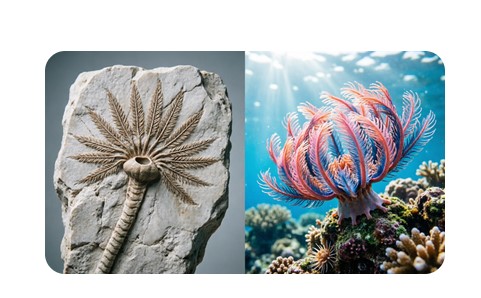
The headline reads, “Paleontologists make ‘one in a million’ discovery of soft tissue preserved in 450-million-year-old fossil.” Okay, now we’re no longer talking about dinosaurs. We’re talking about a crinoid- a filter-feeding marine invertebrate with a flower-like body and feathery arms that flourished wayyyy before the first dinosaurs ever existed.
Researchers have actually identified soft tissue in two crinoid fossils. Paleontologist Dr. David Wright remarked, “It’s incredible these soft tissues have survived more than 450 million years.”
What’s even more remarkable is that the fossil had been sitting in a museum collection for years before anyone examined them closely. They weren’t freshly excavated or specially preserved.
More importantly, crinoids don’t have blood. They don’t use hemoglobin to transport oxygen. If iron from blood is supposed to explain exceptional preservation in dinosaurs, that explanation cannot apply here. So another rescue mechanism is needed.
It’s also worth noting that although millions of crinoid fossils have been discovered, very few scientists have looked for soft tissue because they long assumed none could exist. So, while soft tissue is indeed rare, it may not be as rare as portrayed in this article.
To me, preserved soft tissue remains compelling evidence for a young earth. Creationists don’t need increasingly elaborate preservation mechanisms to explain why these materials still exist. If these organisms were buried rapidly during the global Flood only a few thousand years ago, the presence of original biological material is exactly what we would expect.
Once again, evolutionary predictions have been revised to accommodate unexpected discoveries, while the creationist prediction that original biological material should still be present continues to be affirmed.