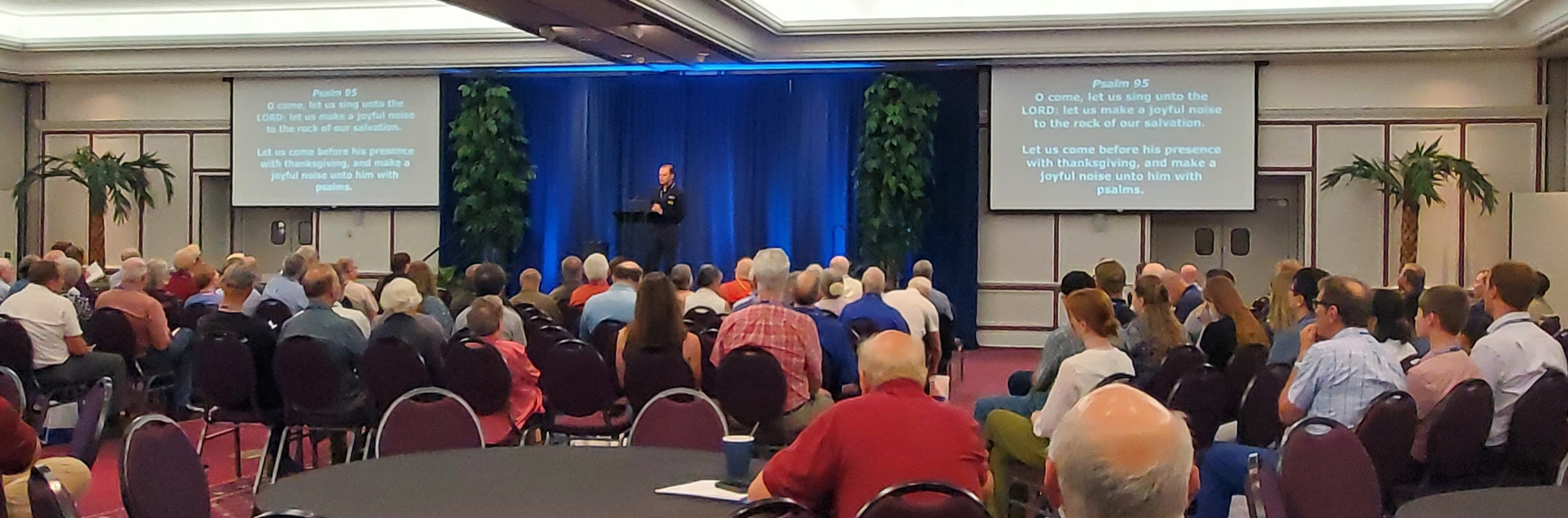
I recently attended this year’s Creation Research Society Conference in Pensacola, Florida, and it was fantastic! It’s always inspiring to see the latest research being presented in biology, paleontology, geology, astronomy, biochemistry, dendrochronology, archaeology, and engineering- particularly in relation to creation and a young earth. Here are some highlights from three intense days.
Perhaps my favorite topics were related to ancient soft tissue and DNA. Researchers have already identified enough soft tissue in dinosaurs that it is no longer questioned- over 100 papers describing biological tissue in dinosaurs and other ancient fossils have been published, but there’s still much to learn.
For years, evolutionary scientists argued that biological tissues could not survive for millions of years. But now they’ve changed their tune, some claiming that it can last indefinitely under ideal conditions due to preservation by iron in the organism while it was living. But this amounts to circular reasoning. It’s an unprovable assumption, supposing long ages are true.
Creation scientists are actively investigating this question by studying collagen, one of the most common proteins found in ancient remains. Researchers are developing decay curves and testing the factors that influence preservation under different conditions. The goal is to determine whether the observed decay rates are compatible with the millions of years assigned to these fossils. If we can demonstrate that original soft tissue cannot survive millions of years, then this is strong evidence that these organisms died recently- within a biblical timeframe.
Current research indicates that iron can actually accelerate certain forms of degradation, while most environmental conditions are unfavorable to long-term collagen preservation. Even under the most ideal conditions, the survival of collagen for tens of millions of years remains a significant scientific question. If the experimental evidence demonstrates that these tissues cannot reasonably survive 66 million years under the most generous estimates, then the conventional age assigned to the fossils becomes problematic.
And what about dinosaur DNA?
Secular scientists have long considered dinosaur DNA essentially impossible to recover. Swedish geneticist Svante Pääbo has argued that it would be “impossible” for DNA to survive millions of years “from what we know about the chemical stability of DNA.” However, Brian Thomas says, “Challenge accepted.”
Creation scientists are searching for DNA that can be identified, authenticated, and potentially sequenced from dinosaur remains. That is an enormous challenge. Researchers must eliminate contamination, distinguish genuine endogenous DNA from bacteria and other microorganisms, and demonstrate that any recovered genetic material actually belonged to a dinosaur or another extinct animal. And if we’re successful, evolutionists will undoubtedly move the goalpost once again to explain how the impossible is possible. DNA is fragile and easily damaged, so success will take time, but some estimate it will happen within the next 5-25 years.
Another fascinating presentation, facilitated by Joel Brown, focused on the latest origin-of-life research, including SpudCell- the first synthetic cell designed with a complete cell cycle. Scientists have assembled a functioning cell from nonliving components, which is an incredible technological achievement. SpudCell can divide, but it must be continuously fed, and it survives only for a limited number of generations before degrading. However, building a cell using human intelligence is not the same as a living organism arising from natural processes alone. Therefore, I’d suggest this is evidence that life requires intelligent design and cannot arise without a creator.
Creationists also accept a global Flood, and researchers are developing increasingly sophisticated models to explain the geological evidence. Catastrophic Plate Tectonics remains one of the leading creationist models. It proposes a progressive and catastrophic Flood involving rapid plate movement, subduction, volcanic activity, and major changes in sea level.
In this model, the fountains of the great deep initiate rapid plate movement. New, hot ocean crust forms as material rises from beneath the earth, displacing seawater and producing major changes in ocean levels. Eventually, as the ocean crust cools and becomes denser, it sinks, drawing water back toward the ocean basins. This would explain the youthfulness of the earth’s crust and movements.
Both the Bible and observable data are factors driving this model, and it even provides a framework for understanding the Ice Age following the Flood. Volcanic activity could inject dust and aerosols into the atmosphere, reducing sunlight and cooling the continents while the oceans remained comparatively warm. The resulting temperature differences would provide the conditions necessary for rapid glaciation.
Tim Clarey discussed Flood boundaries and proposed an upper Flood boundary near the Neogene-Quaternary boundary in the Cenozoic. The enormous scale and apparent rapidity of sedimentary processes remain important questions for any model of earth history.
One criticism often raised against Catastrophic Plate Tectonics is the so-called “Heat Problem”- the argument that such rapid tectonic activity would produce enough heat to boil the oceans. Dr. Clarey argued that this objection is not as straightforward as it is often portrayed and is really just a problem in perception
Hydrogeologist Troy Smith presented aerial and photographic evidence of rapid deposition and soft-sediment deformation associated with the early stages of the Flood. In the Appalachian Plateau, continuous sedimentary layers can be traced across enormous distances. Yet some folded formations contain multiple layers that appear to have been deformed while the sediments were still soft.
That is significant. If these layers were already hardened rock when they folded, we would expect fracturing. Instead, we see extensive folding without the breaks one might expect from deforming solid rock. This suggests that the sediments were still unconsolidated when the deformation occurred- evidence that fits remarkably well with rapid, catastrophic deposition.
A session by Carl Werner on “Deconstructing Lucy” provided valuable evidence that Australopithecines were just an extinct type of ape with no evolutionary ties to humans. Features such as the curved toe bones, ape-like knee, no projecting nasal bone, large canine teeth, and other skeletal characteristics raise serious questions about how Lucy has historically been reconstructed.
Werner also discussed the Laetoli footprints and several anatomical features that have been used to argue for Lucy’s place in human ancestry, including the bicondylar angle of the femur, patellar surface, flat lateral condyle, pelvis orientation, pubic bones, spine, fourth metatarsal, and the sacrum. Interestingly, recent reconstructions of Lucy have become more ape-like over time. Even the Smithsonian’s reconstruction depicts an animal with distinctly ape-like features and long, curved toes. And many evolutionary scientists today place Australopithecus on a side branch rather than directly on the human line.
Here’s a quick rundown of several other sessions I enjoyed:
Marshall Jordan: Provided evidence for multiple tree-rings per year and is calling for revisions in dendrochronology related to the Bristlecone Pine.
Joel Leineweber: Presented anatomical evidence challenging the claim that dinosaurs evolved into birds.
Gabriell Haynes: Discussed the reliability of data and taxonomic stability for future discussions of Flood boundaries.
Dr. Hill: An in-depth examination of the antimatter problem for the Big Bang model.
Mark Horstemeyer: A fascinating proposal involving torsion boundary conditions that could produce rotational effects from the largest structures in the universe down to the smallest scales- raising profound questions about cosmic design. Indeed, the universe looks designed, and a torsion boundary condition applied to the cosmos would be evidence of God’s creation.
I loved being part of this in-depth look into creation science, and it’s encouraging to see where we’re going. As my friend Eric Hovind often says, this is a great time for creation science. And after three days of presentations covering everything from dinosaur proteins and DNA to geology, genetics, astronomy, and engineering, I can certainly see why.