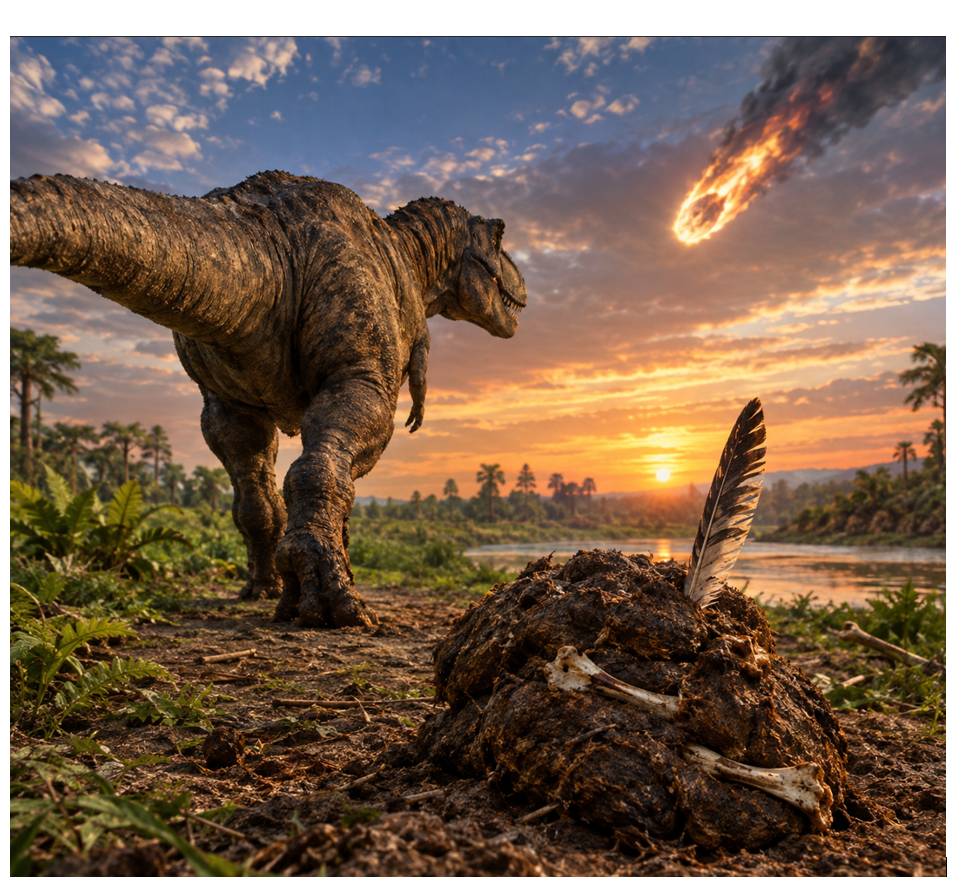
What can a single feather found in fossilized dinosaur poop really tell us about the past? According to a recent ScienceDaily headline, quite a lot: “66-million-year-old feather in dinosaur poop may reveal why birds survived the asteroid.” But before we accept speculation, let’s separate what was actually discovered from the story built around it.
The fossil itself is remarkable. Researchers discovered a beautifully preserved feather, along with bird bones and fish scales, inside a coprolite- a piece of fossilized dung. The bird is likely a hesperornithiform, an extinct group of aquatic, mostly flightless birds. Scientists believe the dung was produced by a large theropod, possibly a T. rex or Nanotyrannus.
But notice how quickly the interpretation expands beyond the fossil- to begin with, we’re fed secular narratives we’re expected to blindly accept; and most people do so without question. First, we are told the specimen is 66-million-years-old. Second, we are told an asteroid struck the earth and killed off the dinosaurs (except for birds). Third, we are told that birds are surviving dinosaurs. And once these narratives are accepted, the author proceeds to weave another evolutionary tale filled with assumptions, explaining why one branch of birds survived while others didn’t.
One of the challenges to the asteroid theory is that many other animals and plants survived. So, if dinosaurs went extinct, why didn’t vegetation, mammals, snakes, fish and birds go extinct too? Surely they would have been affected by the fallout, right? Thus, scientists have long been trying to flesh this out, and here’s the explanation: “The extinct bird it came from had more primitive insulating feathers, suggesting superior plumage may have helped the ancestors of living birds endure the deadly impact winter.” That’s it!
To evolutionists, this explains why modern birds survived the impact. The researchers theorize, simply, that birds with advanced plumage were best able to keep warm.
But there is an obvious question: How do they know? The researchers did not put these extinct birds in a freezer and measure their body temperatures. They cannot observe how these feathers functioned in a supposed “impact winter.” Like a detective, researchers are reconstructing an explanation from fossilized remains to solve a mystery. In fact, lead author Jingmai O’Connor said, “it made me feel like a detective, piecing together all these little clues.”
I think that admission is important. Paleontology is a forensic science; it necessarily involves investigating the past and reconstructing events that cannot be directly observed. However, sometimes forensic scientists (being human) make mistakes, and the wrong person is convicted. In the same way secular scientists make mistakes too, and it could take decades or centuries to correct, and by then the damage is done (ex. Piltdown man).
That does not make the science worthless, but it does mean we should distinguish between observation and interpretation. We can observe a fossil feather. We can observe bones and scales preserved in the coprolite. We can study the feather’s structure. But we cannot observe an asteroid impact 66-million-years ago and watch birds struggle through the resulting winter, or measure which feather type kept them alive.
There are other problems with the proposed explanation. Hesperornithiforms were aquatic birds adapted to life in and around cold water. If their primitive feathers were so inadequate at retaining heat, how did these birds successfully survive in their environment before the alleged asteroid catastrophe? No answer is provided.
The study also describes birds as a “highly specialized branch of the dinosaur family tree.” This statement is loaded. How does evolution redesign a dinosaur body to become ‘specialized’? How does evolution turn a flightless creature without feathers into a flying creature with feathers? We don’t see this happening to other animals today, so why would anyone assume this happened in the distant past where the claim is unobservable and not open to the scientific method?
As a young-earth creationist, I reject the 66-million-year timeline and the evolutionary assumptions used to interpret these fossils. I believe the biblical account provides the correct historical framework: God created distinct kinds of animals, and a global Flood catastrophically reshaped the earth. The fossil record should be interpreted within that framework rather than forcing every fossil into an evolutionary story.
So what does this remarkable feather actually tell us? It tells us that a bird was eaten, its remains passed through a large predator, and remarkably delicate feathers survived the process of fossilization. That’s fascinating. It gives us evidence about the animal’s anatomy, diet and environment. But it does not contain a timestamp of “66 million years,” nor does it come with a video of an asteroid impact and its aftermath.
All this is just one reason why we don’t need to accept fancy evolutionary stories. Sometimes the smallest fossil can expose the biggest assumption: The feather is real, and it is observable. The evolutionary story attached to it is not.