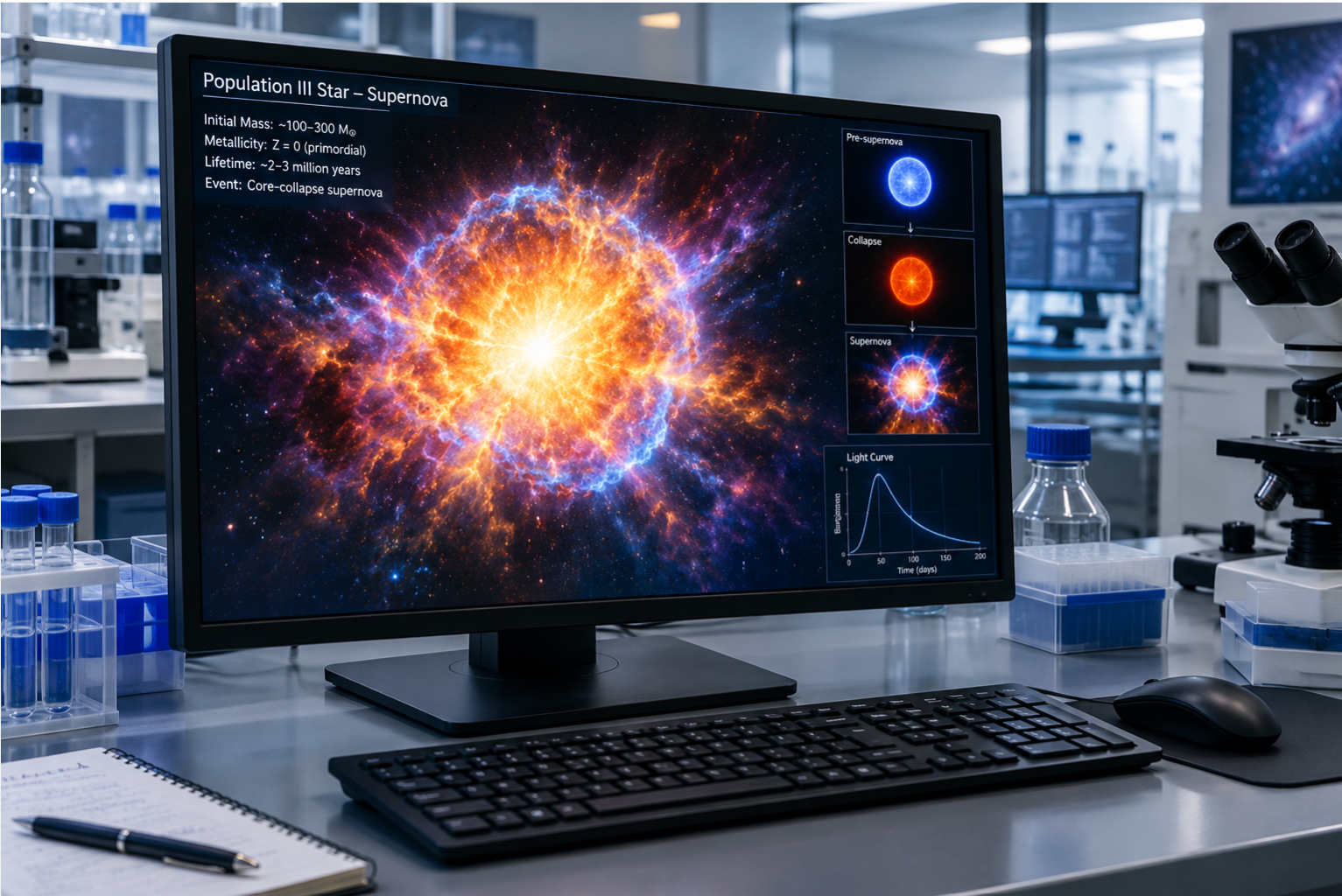
Here’s my second post to close out World Space Week.
How did the first stars light up the galaxy and make life possible? The attached article from Science Daily provides a secular, naturalistic explanation that doesn’t require God’s existence. Of course, we can accept the biblical explanation, whereby God created the heavens and earth in six days (Exodus 20:11).
Personally, I’m saddened that modern science doesn’t give God the glory (or credit) for the incredible universe he’s created. The article simply describes how some researchers think the universe could have come about by time, chance, and a few light elements- like helium and hydrogen. Unfortunately, a lack of evidence stands in their way.
But here’s the kicker… powerful computer simulations have come to the rescue!
Many scientists believe the universe is 13.8-billion-years-old (that age has been altered many times) and credit the Big Bang for its existence. Cosmic evolution allowed dense gas to collapse under gravity and form the first stars, which exploded and sent heavier elements throughout the universe, seeding planets with the potential for life.
That’s a great story, but is there any evidence that any of it is true, or is it simply a modern-day fairytale? Well, if you adhere to secular science, then, odds are, you take it as fact.
However, my last post discussed how the evidence for pristine stars is missing, and researchers using the James Webb Telescope admit that the universe isn’t “nearly as pristine as scientists thought.” So, if evidence for the model can’t be found, what do scientists do? They create a rescue mechanism to make the data fit their model.
In this case, they used a powerful computer simulation filled with evolutionary parameters. Interestingly, the simulation assumes that the secular cosmology is correct, and this allows scientists to analyze the results and further confirm and refine their theories.
GIGO… garbage in, garbage out. If the simulation is fed incorrect data about the beginning of the universe, then the results will be flawed, but the scientists will never know because they got the desired results. Circular reasoning at its finest. Brilliant!
Notice there’s no uncertainty about the results: the headline declares, “Powerful simulations reveal how the first stars changed the universe.” This is a statement of fact, not theory. It’s not a belief… it’s their reality. And the subtitle continues: “Powerful new simulations are recreating how the first stars lit up the Universe and forged the elements that eventually made planets and life possible.” It’s “how” not “if,” and it’s not debatable.
Never mind that nobody has ever observed the emergence of life from nonlife. No. That’s assumed, along with the idea that the first stars seeded the universe with elements.
Of course, this secular worldview is at odds with the biblical worldview, whereby God created stars on Day 4, and Adam could see them on Day 6 after he was created from the dust of the ground. Thus, for those who wish to explain a world without God, a naturalistic explanation is mandatory, and this is one way to do it.
The article states that the simulation “allows researchers to investigate how generations of stars alter the gas inside and around galaxies across billions of years of evolution.” However, this isn’t a real investigation. That’s like prosecuting an innocent man and twisting the evidence to ensure the investigation finds him guilty based upon their assumption of guilt. They’re going to get what they want. Regardless, nobody can observe or “investigate” history unfolding by analyzing the data from computer simulations.
The article admits these assumptions: “The simulations begin with pristine gas containing no heavy elements, reproducing conditions that existed shortly after the Big Bang.” This isn’t confirmed by the data. In fact, the data says the opposite- no pristine, Population III stars have ever been discovered. Yet the simulation depends on them.
The real scientific observations are actually consistent with biblical revelation: God created a sky full of mature stars four days into his creation, so the earth and universe already contained all the elements when God began creating life.