Evolutionists love to claim that the evidence for evolution is overwhelming, but when we examine the evidence, skepticism and caution are in order.
Consider this article from Discover Magazine where evolution is unchallenged and thought to be an undisputed fact. One problem is that the original facts were never facts to begin with; instead, they were conclusions. And their conclusions were interpretations of the facts based upon an evolutionary worldview. But when their conclusions get overturned, it becomes evident that they were wrong. Therefore, their conclusion would be more accurately described as a belief (not fact).
Another problem is that their new interpretation doesn’t cause them to deny evolutionary theory. When evolutionists get something wrong, they simply reinterpret the evidence to fit their worldview- something they accuse creationists of. And they are guilty.
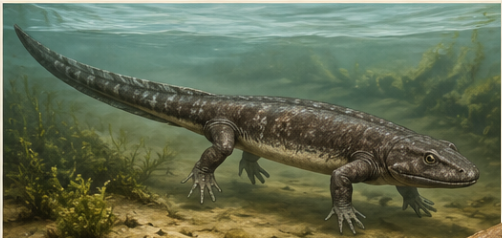
Based upon two slabs of stone, an iconic fossil specimen known as “Lizzie” (for ‘lizard’) was, according to the evidence, the oldest known reptile. This was believed to be an undisputed fact. But now Lizzie is thought to be a stem tetrapod and not a reptile, and this, now, is to be accepted as the new fact. See how that works?
Notice that the author of this article leads off with a statement of faith: “Millions of years ago, vertebrates underwent a major evolutionary transition that gave them limbs.” However, this statement has never been substantiated. It’s assumed based upon evolutionary theory, which relies upon circular reasoning. Nobody witnessed such a transition. So we ought to pay attention when the author states “there are still a lot of uncertainties” around this “fundamental transformation”.
In other words, they don’t doubt there was any transformation. No, the uncertainties have to do with making the new data fit evolutionary theory as fact. Thus, the new explanation will be used to support evolution just as the old one did. No evidence would cause a true evolutionist to question evolution. Of course, this means that evolution cannot be refuted, so it is not real science.
One researcher, Xavier Jenkins, admitted, “when we were finally able to see inside the fossil, we found an animal that looked very different from what we expected.” This is because the new evidence contradicted the evolutionary timeline. The original interpretation allowed them to “pinpoint the timing of amniote evolution.” However, now that Lizzie is no longer an amniote, the timeline must be altered.
Co-author Ben Igielman made another telling statement: “It turns out looks can be deceiving, and Lizzie lived a completely different lifestyle than we previously thought.”
Looks are deceiving? Many evolutionists won’t admit this because, in their view, their interpretation is always right, which means they can’t be deceived by looks. I’ve been told that, once we have a fossil, the physiology cannot be disputed. Based on the looks of the fossil, they think they know everything there is to know about the living specimen. But this case study demonstrates otherwise.
Now, based on the gills, they know that Lizzie was aquatic.
All this changes where evolutionists place Lizzie on the tree of life, which, as we can see, is arbitrary and subject to constant revision.
The following quote demonstrates another refutation of evolution. According to Roger Benson, “This is a big surprise. It shows that, although we think of amphibians as being more ‘primitive’ than reptiles today, some of the traits of reptiles were already there in the ancestor of both amphibians and reptiles.”
And this leads us to ask, if the traits were already there, then where is the evolution?
At some point one must recognize that the theory of evolution doesn’t live up to its reputation and that an alternative is in order. And that alternative is biblical creation. Organisms appear suddenly in the geologic column, with no direct evidence of evolution.